HISTORY OF THE WASHINGTON NAVY YARD
FROM THE YEAR 1890
By Capt. C. Q. Wright, Ch. C. U. S. N.
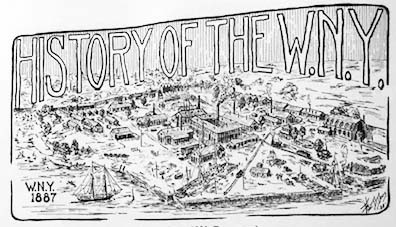
PAGE 104 The former chapter of the history of this Yard already printed, extended from 1799 to 1890, and this chapter begins with the latter year and brings the story of the Yard and Station down to date--necessarily, in a very condensed form. Adopting the method of recording this history from year to year, the story for the year 1890 was as follows: The industrial activities were slight, comprising of construction of quarters for officers, extension of local railway tracks, improvements to the Gun Factory Plant, and in the latter department the erection of a 110 ton crane, a shrinking pit, and several additional buildings. An immense reduction in the cost of manufacture of eight inch guns was accomplished mainly by the new and improved methods of manufacture. It may be noted that up to and including this year the guns were proved and powder tested here on the water front of the Yard. In 1891 Commodore Skerett was Commandant and Commander Charles O'Neill was Ordinance Officer, and by recommendation of the Bureau of Ordnance, line officers were studying gun construction, and certain Army officers obtained permission to study the methods of the Gun Factory.
There was, of course, a permanent civilian force; two foremen, eight master mechanics, four leading mechanics, an average number of 930 employees, of which 58% were drawn from the District, 21% from Maryland, and 21% from others parts of the United States. The number of draftsmen was slightly increased this year and detailed drawings were made from the gun mounts of four vessels--finished drawings and blueprints 12,000. The merit system was adopted and a board for the selection of employees inaugurated; and the usual class of Seamen Gunners under instruction averaged 28. The Reverend W. G. Isaacs reported for duty as Chaplain of the Yard. It was during this year that a furnace for treating armorplate by the Harvey PAGE 105 process was erected and plates were treated for experiment trial; a chemical laboratory was established; a second large lathe for eight and ten inch guns was purchased; large machinery for the manufacture of breech mechanism, mounts, etc., for rapid fire guns was installed. There was built a sixty ton crane for Indian Head at one-third the cost asked by private manufacturers. Improvements were noticed in the character and amount of motion of work at the Gun Factory which was attributed to the merit system of promotion of personnel. Records show that the Gun Shop operated daily, ten to twelve hours, with a force of 115 men; in the projectile shop were 75 men; in the mount shop 67 men, tool room 56, breech mechanism 123; coppersmith shop 35; foundry shop 85; forge shop 45; pattern shop 14; 405 new machines were installed for the Gun Factory where mounts and mechanisms for ten and twelve inch guns were designed as well as breech mechanisms and mounts for rapid fire guns; and there were completed the first twelve inch gun and mount; the first ten inch mount, Mk II, the first 35 and 40 calibre six inch guns; the first 4 and 5 inch rapid fire guns and six-pounder field guns; and numerous other projects designed and constructed.
In his report for 1892, the Secretary of the Navy concluded that the Washington Navy Yard and Gun Plant was the foremost of its kind in the country both in administration and material, and by this time the Gun Factory Plant was conceded to be one of the finest in the world. Commander O'Neill, Ordnance Officer, was relieved by Captain W. T. Sampson. The average number of employees in the Gun Factory was (899?) producing 12,000 common shells calibre four to thirteen inch as well as a large number of guns. There was installed the latest designed turning lathe possessing special features: a rifling machine was manufactured in this Yard for heavy guns; hot air furnaces were put in operation in the sinking pit and miscellaneous projects and improvements were features of this year. It was during this year that a wire wrapped gun was appropriated for, made, tested and rejected.
The following inscription is borne on a tablet plate placed on the northern end of the North Gun Shop Building:
U. S. NAVAL GUN SHOP
Commenced May 1887
William C. Whitney, Secretary of the Navy
Captain Montgomery Sicard, U.S.N. Chief of Bureau of Ordnance
____________
Completed September 1892
Benjamin Tracey, Secretary of the Navy
An event of the year was a visit of respects by President Harrison1893--Commander Theodore F. Jewell was in command of the Gun Foundry with an average of eleven officers on duty. The record shows that the Surgeon of the Yard reported health conditions satisfactory; additional space was provided for by Congress for the expansion of the Station but considerable delay and embarrassment was experienced in the work of the plant owing to difficulty in obtaining suitable steel, notwithstanding which the shops completed 303 steel S. B. rifles, 307 gun carriages and mounts; 324 secondary battery mounts; and a large number of projectiles, besides six ammunition hoists for the U.S.S. NEW YORK, COLUMBIA and other vessels.
Repairs were made to the machinery of the U. S. S. DALE, DOLPHIN, TRITON, and WYANDOTTE, and there was considerable activity among the vessels and on the wharves at the water front and in the shops relating thereto.
PAGE 106 In 1894 Captain John A. Howell was in command of the Yard and Station, there being no other changes noticed in the record of administration of the establishment. By this time a number of enlisted men were being instructed at the Gun Factory as well as the usual quota of commissioned line officers. Appropriations as well as the usual quota of commissioned line officers. Appropriations were made for the further extension of the Yard, for extensive repairs to buildings, and for additional machinery. Repairs were made to the machinery of five vessels; and it is worthy of notice that on December 13th of this year the famous old Receiving Ship "DALE" was put out of commission after a long and notable career. The social life of the Yard which as always been a notable feature was marked by the usual pleasant functions in and around the officer's quarters particularly at the close of the year.
1895--Progress was being made at the Washington Navy Yard, and we hear of projects, facilities for manufacture, adoption of the latest devices, etc., and the secretary of the Navy classes the factory as an "Admirable gun plant." Changes were made in the labor situation. Men under instruction housed on the DALE were moved to the Seaman Quarters in the Yard and instructions in Seamanship and Ordnance continued, when that venerable vessel was put out of commission. When the upper shiphouse was taken down, the stone landing-ways were utilized to raise the sea wall to prevent the high tides from coming over it into the Yard.
483 B. L. rifles were manufactured and in course of completion, and 533 gun mounts; and 238 S. B. mounts and ammunition hoists for the U.S.S. INDIANA, OREGON and MASSACHUSETTS, besides numerous other products of the gun plant such as projectiles, torpedo tubes and miscellaneous work.
Repair were made to the machinery of five vessels. The sanitary conditions were reported good, and the year was concluded in the usual routine, unmarked by any special events at the National Station.
In 1896 Commodore Charles S. Norton was Commandant and Commander Charles O'Neill had charge of the Gun Plant, having on April 8th relieved Lieut-Comdr. Leutze, who in turn had relieved Commander T. F. Jewell, on February 20th of that year. Recommendations for the reclamation of the lowlands between the Yard and the Anacostia River were made to Congress; repairs were made to the U. S. S. CUSHING, and TRITON, and other vessels at the water front; and the U,. S. Naval Hospital removed from 9th and Pennsylvania Avenue, Southeast to the new building at 24th and Boulevard Northwest, nearly a year having been consumed in the transfer of patients and property to the new location.