CONTINUATION
Commodore David Porter (February 1, 1780 – March 3, 1843) letter June 1812 vividly describes an attempt to tar and feather, Seaman John Erving of the USS Essex, one of its sailors. The Essex was in Brooklyn to refit and reprovision. In the War of 1812 nationalist political passions and along with accusations of treason or disloyalty ran against any persons like Erving who would not swear allegiance. David Porter as Captain of the Essex found himself caught between those who wanted to make poor Erving an example and his desire to protect the seaman and abide by the law.
Tar and Feathering
Source: LS, DNA, RG45, MC, 1812, Vol. 1, No. 72.
U.S. Frigate Essex
Navy Yard Brooklyn
28 June 1812Sir,
A circumstance that occurred on board the Essex, the day before yesterday excited some interest in this place and may produce some enquiry from the Department.
John Erving an American seaman belonging to the Essex, declared himself to be an Englishman when called upon to take the oath of allegiance. The crew requested me to permit them to tar & feather him, and turn him out of the ship with appropriate labels on him. I consented. The Police to prevent a riot took him in charge. The British consul I am informed has declared him to be an Englishman, and is about engaging a passage for him to Halifax. The Police Office I am told has consented to this measure. Erving has already had an interview with the Consul.
Yesterday the enclosed correspondence took place between me and a magistrate of the Police Office & it was from the bearer of the letter that I received information of the above arrangement. I desired him to inform the officers of the police that I should protest in the most solemn manner against the delivery of Erving to our enemy, who may through him obtain much information respecting our Navy. Perhaps Sir, there may be such a character on board each of our vessels. I have the honor & c.D Porter
[Enclosure]
City of New York, June 26th 1812
John Erving being duly sworn, deposed & saith that he was born in New Castle on Tyne (England) that he has resided within the United States of America since the year 1800, is a Sail Maker, has never been naturalized in the United States. That on the 14th day of last Oct 1811, he entered at Salem in the capacity of Sail Makers Mate, for the frigate Essex, that he joined said Frigate at Norfolk on board of which he continued until this day, that about 9 o’clock this morning all hands were piped to muster when Captain Porter (Capt. of said Frigate) told the hands that they were called up to take the oath of allegiance to the United States, and gave them to understand that any man who did not choose to take the oath should be discharged, that when deponent's name was called, he told Capt. Porter that he, the deponent, could not take the oath required, being a British subject, on which Capt. Porter called the Petty Officers and said to them, that they must pass sentence on him the deponent, on which the said Petty Officers put him in the Launch which was alongside the Frigate and there put a bucket of tar on him, and after which laid on him a quantity of feathers. They then rowed said Launch stern foremost on shore on New York Island and put him on shore, but whereabouts deponent does not know as he was never here before. That deponent went from Street to Street naked from the waist up, smeared with Tar & feathers, not knowing where to go when a man (Benjamin Ford) told him to go into his shop from the mob, or crowd of people then around him, that he stayed in said Shop until the Police Magistrate took him from thence and put him in the City Prison for protection, where he has been cleansed and got a Shirt & Trousers. The deponent further swears that none of the citizens, or inhabitants of the City of New York done him any manner of injury, or insulted him, but that he has been assisted and protected by the civil authority thereof
(Signed) John Erving
Taken & Sworn before me in the
Police Office of the City of New York
June 26th 1812(Signed) Charles Christian
Special Justice of the peace for said CitySource: DNA, RG45, MC, 1812, Vol. 1, No. 72.
[Enclosure]
(Copy)Police Office City of New York
June 26th 1812Sir,
The bearer John Erving was this morning put on shore in this City, Tarred & Feathered – the Mayor of this City, the Justices at this Office, and the citizens without exception have protected him. Finding on examination that the said Erving is a British Subject and a total stranger in this City, I therefore refer him to you for further succor. Your Obt Servt
(Signed) Charles Christian
Special Justice of the Peace
Thomas Barclay EsqrSource: DNA, RG45, MC, 1812, Vol. 1, No. 72.
[Enclosure]
Police Office, City of New York
June 27th 1812Sir,
I had the honor this moment to receive your note of the present date, and in consequence of the information it contains, I have committed John Erving, with a view to his safe keeping, and further examination of this subject, as a disorderly person. Presuming that a perusal of his examination at this office may be useful to you individually or to the service, I have communicated it by Mr. Montgomery (Police Officer) with instructions to return it to this office; should you judge proper a copy of it is entirely at your service. Respectfully [&c.](Signed) Charles Christian
David Porter Esqr
Capt. U S Frigate Essex-
BrooklynSource: DNA, RG45, MC, 1812, Vol. 1. No. 72.
[Enclosure]
Commanding officer on board
The Essex Frigate
Police Office
New York
June 27th 1812Sir,
John Erving, who was landed in this City yesterday from the Essex, says that his clothing is on board that Frigate. He is in the care of the Police of this City who have given him a Shirt & Trousers. If you judge proper to give his chest and clothes to the bearer, Mr. Raynor, Police Officer, he will receive them. Erving says that the Armorer of the Essex can inform you where his clothes is placed. Your Obt Servt(Signed) Charles Christian
Special JusticeSource: DNA, RG45, MC, 1812, Vol. 1, No. 72.
*
[Enclosure]
U.S. Frigate Essex
27 June 1812Sir,
John Erving is an American Citizen; I herewith enclose a copy of his protection. His clothes cannot be delivered until I am furnished by the Purser with a statement of his accounts, should he not be indebted to the United States they shall be delivered to your order. Very Respectfully [&c.](Signed) D. Porter
Charles Christian Esqr
New YorkSource: DNA, RG45, MC, 1812, Vol. 1, No. 72.
[Enclosure]
(Protection)
United States of America
No: 189Virginia,
I, Larkin Smith Collector of the District of Norfolk & Portsmouth, do hereby certify that John Erving an American Seaman, aged twenty-three years, or thereabouts, of the height of five feet four 1/4 inches, of a light complexion, brown hair, Grey eyes, born in Salem in the State of Massachusetts, has this day produced to me proof in the manner directed in the act entitled " an act for the relief and protection of American Seamen" and pursuant to said act, I do hereby certify that the said John Erving is a citizen of the United States of America.
In witness whereof,
I have hereunto set my hand & seal of office
This 23rd day of April
One thousand eight hundred and eleven
Seal
Signed Larkin Smith
CollectorI certify that the above is a true copy of the original.
W.W. BostwickSource: DNA, RG45, MC, 1812, Vol. 1, No. 72.
SECRETARY OF THE NAVY HAMILTON TO MASTER COMMANDANT DAVID PORTER
Capt. David Porter Navy Dept
New York 30 June 1812
I have just received your letter of the 28 Inst.
It is much to be regretted that you gave sanction to the proceedings on the part of your crew in the case of John Irving. It is indeed to be regretted that you did not suppress the proceedings. Mobs will in Spite of all Law, sometimes Act licentiously, but Mobs should never be suffered to exist on board of a Man of War, while order discipline & a perfect observance of the Law should be enforced. Tyranny in whatever Shape it may appear ought to be resisted by all men. I do exceedingly regret that an officer of your rank and intelligence should have permitted the proceedings in question.P. Hamilton
Source: DNA, RG45, SNL, Vol. 10, pp. 81-82
Commodore Samuel Evans to the Secretary of the Navy, 20 July 1815 re Plans for the Navy Yard
Source: RG45
U.S. Navy Yard New York
20th March 1815Sir,
It is an old maxim, which the majority of the people of this country, are now I believe to admit as correct, that peace is the Reason to prepare for eventual war. The war we have just gloriously concluded was a war waged almost for national independence, against an adversary whose means of annoying us is more powerful than the rest of the world combined. He had been foiled in all his projects, and beaten, at his favorite projects until he has been compelled to acknowledge the strength of our arms and the justice of our cause by subscribing to a peace honorable to us as a gallant and powerful nation. The share the navy had in producing this desirable event, has been the theme of admiration and praise, both at home and abroad, and when we are again involved in a contest for our rights, be it with whom it may, it is not unreasonable to calculate that much will be expected from the navy. Hence then arises the policy and necessity of availing ourselves of this most favorable period, to introduce regular Systems for every branch of the Naval Service, to revise and correct the regulations we have, and to establish such additional ones as may be wanting for genius of maritime warfare. The establishment of the board of commissioners promises to be of vast importance to the nation at large, and from the talents that are incorporated in it, the navy is sure to reap incalculable advantages from it, as will be benefited by their engineers and laborers.
I consider it the duty of all to contribute to them, and if the remarks I am about making (which I should be pleased if properly laid before them on their meeting) on a branch of the civil Department of the service, shall not be considered in time, & because we unasked for, and should be the cause of soliciting one idea that would to an improvement in the service, if it will be productive of happiness to me.
It would be presumption as well as waste of time, to use argument to convince you of the vital importance to a maritime nation of well-established Dock Yard for building and repairing their Public ships, with the small force we have heretofore had, the want of them has been severely felt, by the public, as well as those officers who have the control of repairs, and I do not believe it extravagant to say, that for want of them and judicious regulation respecting the purchase and accountability of stores, all expenses that class under the head of repairs and that you know is a large item in naval expenditures, are increased Twenty five or Thirty per cent but even this, great as it is, is far from being the most important evil that may arise from the want of them, our late enemy, while he exists as a nation, will never entirely divest himself of that character, either openly or covertly, he will, as it were from nature maintain that feeling toward us, "the more we prosper, the more vindictive will be the of his exasperation, vanity, and the deeper and more deadly will he aim the vengeance of his wounded pride. It therefore disposes (indeed it may at some time be essentially important to us as a nation) to be so far on the alert as to be enabled to equip all the force we may have, at the shortest possible notice, and that we can never do until there is a radical reform in the civil Department of the Service. The first question of importance on this subject that presents itself to me for consideration is the location of the different Navy or Dock Yards. How many of them shall we have? Where shall they be permanently established? What shall be their extent, conveniences for building, repairing, equipping &c &c and their appointments?
We have I believe six established Navy Yard Viz., at Portsmouth, Boston, New York, Philadelphia, Washington and Norfolk. The one at Portsmouth I only know by report, the situation of it though I believe to be eligible, and I should calculate on that as being permanent. The one at Boston I should view in the same light. If it is necessary or expedient, there should be one at Philadelphia, I would recommend changing site, or purchasing more ground on the river. I believe there is not near sufficient for an efficient establishment. It is considered advisable to have one grand Depot for Building, the policy of which at this time I much question, it should be at Washington, at any rate in the improvements made in the Yard there, regard should be had to its being a great arsenal hereafter. The one at Norfolk is also in want of front on the water for a permanent establishment, and the one I write from would be much better in every respect, if we had the point of land adjoining to the West, and which could be at this time be purchased, I expect for 40,000 dollars, to these I would add one at Rhode Island, one at Port Royal, South Carolina, and one at New Orleans. The two latter should be at present on comparatively small scale, but capable of such extension as might be found necessary, but the one at New Port should be the grand rendezvous for one fleet and depot of materials for repairs and equipment. I consider its advantages for these purposes superior to any in the U. States. Each yard should if possible contain Fifty acres, Although it would lose us time in having every Yard laid out in the most convenient manner for building, repair &c &c and having every stone or stick that was laid in it hereafter placed in conformity to the great plan adopted, I am never the less of the opinion that it is necessary at this time to incur what would be a serious expense on them, in a national point of view. I would limit the improvements yearly, at the different yards as circumstances might seem to require, and none of them when contemplated should be calculated to have more improvements than follows: Good stone walls to guard them, A dry dock and two building slips, with necessary moorings, and a sheer hulk to each, Receiving stores, Carpenters, timber, and mast sheds, coopers, block makers, Boat builders, Painters, Blacksmiths and Plumbers shops, Rigging and Sail Lofts, Rope Walk, Magazine Armory and offices, with houses and buildings for officers attached to the establishment who should all live in the Yard.
Where ever there are Marine quarters in the Yards, they should be converted to the use of the officers and the marines accommodated elsewhere. I consider a Navy Yard a most unsuitable place for more marines than are necessary to guard it, and they should be relieved daily. To each of the most important Yards I would allow the following officers, petty officers and seamen exclusive of the ordinary men: A Captain, a Store Keeper, a Purser, a Surgeon, a Chaplain, a Superintendent of the Rope Walk, A Master of Ordinance and assistants, a Blacksmith, a Joiner, a Mast Maker, a Cooper,, a Boat Builder, a Sail Maker, a Block maker, a Painter, a Armorer, a Plumber, a Master of the teams and laborers, a Porter, thirty seaman and seventy laborers and such clerks in the higher departments as may be considered necessary, but salaries of the whole number of clerks employed should not exceed a specified sum. In regard to the officers enumerated I will only observe, that where there is so much public trust and responsibility, as must necessarily be imposed on them, it will in my opinion be beneficial, to be rather liberal, than parsimonious. I would let every rank be satisfied that their comforts were not unattended to, and promotions in their line should be held out as a reward for zealous and faithful service. The number of artificers to be employed in each Department requires some consideration. It would be the height of national prodigality to establish Navy Yards, and appoint the officers I have enumerated, with employing at all time a certain number of mechanics in each Department, but I am not satisfied in my own mind, that economy would result from an extensive and indiscriminate manufacture of naval equipment in our Dock yard, without more experience on this subject, I should decline advising the extending on this subject, much beyond the manufacture of articles in which quality and dispatch is a greater object than cost, these however include articles and considerations, and important, for it never should be forgotten that the efficiency of our Navy will depend more on the mind and condition of our ships and the facility with which they can be put in motion than the number of them.
I believe the following number of mechanics could always be employed to advantage in the principal yards, in the Carpenters Department or under his immediate superintendence, one hundred and twenty Carpenters and Joiners including Boys and assistants, Ten Mast Makers, Ten Boat Builders, Ten Block makers, Ten Painters, Five Plumbers, Thirty Blacksmiths under the immediate superintendence of the master exclusive of his assistants, the Boatswain and his assailants and the seamen and laborers enumerated, Twenty Sailmakers, under the immediate superintendence of the master of the ordinance, including armorer and assistants, ten under the immediate superintendence of the Rope walk – Twenty under the immediate Superintendence of the Store Keeper including his assistants, Ten Laborers, and six watchmen under the immediate Superintendence of the Cooper, Ten making a great total of three hundred and ninety two officers, petty officers, artificers, seamen, laborers and boys.
I am not certain that the classes are so divided as to prevent one branch from interfering with or waiting for the other. A reasonable discretion, however, should be left with the Commandant to enable him to apportion the classes according to circumstances, but not to increase the whole number, unless authorized by the Department –
As it regards the nature of contracts with them, and their pay and subsistence, I will only remark now, that I am of the opinion it would be advisable to engage them to serve, during good behavior, with daily payment subject to such checks and deductions, as the regulations may prescribe. I would issue no ration to any such person belonging to the establishment.
Samuel EvansComplete Musters of Officers, Mechanic’s and Laborers.
Source: 17 Mar: 1817 Circular from Board of Navy Commissioners to Commodore Samuel Evans (E307 v.1)
"You will send to this office, as early as possible, a Complete Muster & Pay Roll of all officers, Mechanicks, laborers & others in the Yard under your command; and on the last day of every month & hereafter, you will do the same. No mechanics or laborers are in the future to be employed under your command without the orders or sanction of the Board of Navy Commissioners."
"No Slaves or Negros .."
Source: 17 Mar. 1817, Circular from Board of Navy Commissioners to Commodore Samuel Evans (E307 v1.)
Note: In this circular dated 17 March 1817 the Board of Navy Commissioners directed to Samuel Evans and all naval shipyards that henceforth no slaves or Negros were to be hired at naval shipyards without the BNC approval. There is no documentation BNY ever employed slaves or free blacks, prior to the Civil War. This action was a response to complaints received from (white) employees at the Washington and Gosport (Norfolk) shipyards to the hiring of slaves and free blacks.
"Abuses having existed in some of the Navy yards by the introduction of improper Characters for improper purposes, the board of navy Commissioners have deemed it necessary to direct That no Slaves or Negroes, except under extraordinary Circumstances, shall be employed in any navy yard in the United States, & in no case without the authority from the Board of Navy Commissioners. Efficient white mechanics & Laborers are to be employed to supply the places of those discharged under this order."
Citizenship
In a circular dated 11 April 1817 the Board of Navy Commissioners directed all naval shipyards that henceforth all employees must be United States citizens.
Source: Board of Navy Commissioners Journal to Commodore Samuel Evans, Subject Citizenship dated 11 April 1817.
"None but citizens of the U. S. are to be employed in any Situation in the Navy yard under your command. Should there be any such at present employed they are to be discharged." (E307 v1)
BNC Journal of same day states "This regulation was founded on the Supposition that Citizens will be less likely to betray secrets, and convey to the Enemy such information that will tend to the disadvantage of the United States" (E303 v 1)
1 May 1817 Regulations re Apprentices
BNY like the other federal shipyards developed its own regulations and pay scales for apprentice workers. However, the creation of the Board of Navy Commissioners (BNC) in 1815 led to a gradual standardization of apprentice regulations. One of the most perplexing problems the BNC faced was the number of apprentices each shipyard trade was to be allocated. This circular letter dated 1 May 1817 to all naval shipyards set forth the following numerical restrictions.
Source: Board of Navy Commissioners to Commodore Samuel Evans, Subject Apprentices, dated 1 May 1817
"When Master Workmen shall be attached to the Navy Yard under your command, they are to be allowed under restrictions, the number of apprentices as follows.
Master Carpenter................ Three
Cooper......................Two
Mast Maker ..............Two
Sail Maker.................Two
Boat Builder .............Two
Blockmaker ..............Two Apprentices are not allowed to be taken into the yard unless they shall be bound for seven years and shall have attained the age of fourteen - For the first two years of their apprenticeship they shall be allowed one fourth the pay allowed to a mechanic of the trade at which they are serving, for the third & fourth years one half, for the fifth & sixth two thirds, and for the Seventh three fourths the pay allowed to a mechanic of the trade at which they are serving."
[End document]NAVY YARD APPRENTICE AGE & PAY RATES
BNC Circular to Commodore Samuel Evans, date 2 July 1817, Subject Apprentice Pay Rates.From the reports received by Several experienced respectable mechanics employed in some of our Navy Yard, the Commissioners of the Navy are moved to believe that rate of wages fixed on for compensation of apprentices, commencing on the 1st day of the previous month the following rates of pay, instead of those directed by our Circular of the 1st May last. For the first year of their apprenticeship, they shall be allowed, one-third of the pay allowed to mechanics of the trade at which they may be serving; for the second and the third years, one-half; for the fourth year two-thirds; & for the fifth years three-fourths. With respect to the ages and terms of Service of apprentices its understood that five years will be sufficient to make them workmen, provided they are intelligent and are 16 years of age at the time they are bound. No apprentices except of such character & age, as is before mentioned is here after to be received into the navy yard under your command. Those apprentices who are at present employed in the yard & bound under different Circumstances may receive the same rates of pay according to merit & terms of service, as they would be entitled to, if they would be entitled to, if they had been 16 years of age at the time of being bound.
PAY RATES FOR CARPENTERS AND BLACKSMITHS
Source: BNC Circular dated 13 Jul 1818 to Commodore Samuel Evans (E307 v1).
The Board of Navy Comms, desirous of making you to employ the most skillful & best Ship Carpenters & blacksmiths are disposed to place at similar work in the different yard as pay as nearly similar as possible have made the following arrangements in relation to pay –
Of Ship Carpenters exclusively of foremen & apprentices there are to be but two classes of one-third of them shall be of the first class & shall be allowed two dollars per day – the remaining class 2/3rd shall be of the second class & shall be allowed $ 1.75 per day
Of the number authorized by our Circular of 22 June to be employed in the Construction of the Ship, when in your opinion such number can be usefully employed, four are to quartermen who are to be allowed each 2.50 per day.
The Blacksmiths & persons employed in the Department when it shall become necessary to employ them agreeably to our Circular of 22 June are to be allowed according to their several & respective merits $ 2- $1.25, $ 1.50, $1.75 & 1.25 exclusive of Foremen.Captain Samuel Evans Explains the Ferry
Source: 27 May 1819 Captain Samuel Evans to Commodore John Rodger BNC re the Ferry. RG 125, Records of the Judge Advocate General Case Number 403 Capt. Samuel Evans Entry 26 – B.
Copy
U.S. Navy New York
May 27th 1819Sir
The repairs we have on hand has rendered it necessary to increase our gang of Mechanics considerably from New York and there is some difficulty in their getting over in season to muster & returning in the Evening to their families; to obviate this I have at considerable loss to myself put an additional Boat on the Ferry I established near the Yard and borrowed two boats being all I could get from the lower service –
There is a large boat in the Yard formerly belonging to the John Adams when a Store Ship, which is seldom used for any purpose and if the Commissioners will allow me to use her on the ferry while there is so many employed, or until I can procure a suitable one it will much facilitate their crossing - It may be proper to state that the Mechanics working in the Yard only pay me one dollar a month for crossing, that my boats will not carry with safety more than 18 persons, that it costs me fifty dollars a month for each boat I have on and that three boats are insufficient for the ordinary purposes of the ferry –
I have the honor to be &c
[Signed ] Samuel Evans
Commodore Rodgers
President of the Board of
Navy CommissionersReduction in Wages by Trade
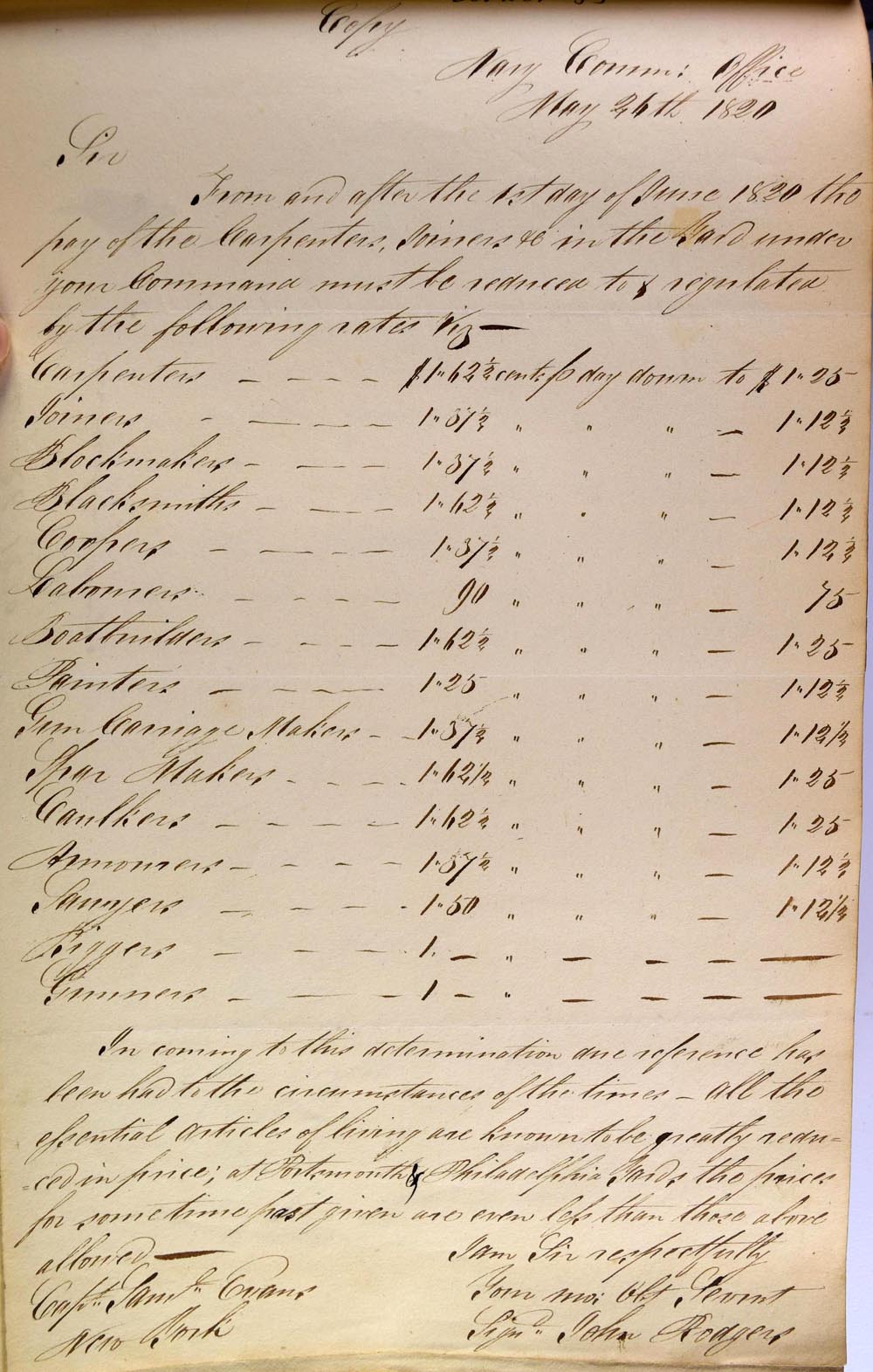
Source: 24 May 1820 BNC Commodore John Rodgers to Captain Samuel Evans, reduction in wage rates RG 125, Records of the Judge Advocate General Case Number 403 Capt. Samuel Evans Entry 26 – B. IMAGE
Copy
Navy Commissioners Office
May 24th 1820Sir
From and after the 1st day of June 1820 the pay of the Carpenters, Joiners &c in the Yard under your Command must be reduced & regulated by the following rates Viz –
In coming to this determination due reference has been had to the circumstances of the time – all the essential articles of living are known to be greatly reduced in price; at Portsmouth & Philadelphia Yard the price for some time past given are even less than those above allowed –
I am Sir respectfully Your most Obt. Servant
Signed John RodgersTo: Capt. Samuel Evants
New YorkThe Launch of the USS Ohio 30 May 1820
The USS Ohio was a ship of the line of the United States Navy and the first built at Brooklyn Navy Yard. She was designed by Henry Eckford, and launched on 30 May 1820.38 Eckford made his reputation as a commercial shipbuilder and had worked for the navy during the Barbary Wars and the War of 1812. After the war he again worked as for the Navy as chief naval constructor at the Brooklyn Navy Yard. In 1817 the USS Ohio was laid down largely as an Eckford-designed 74-gun frigate. The design established a model upon which "74s" were built thereafter. Eckford resigned from his post at the yard on 6 June 1820, the week after Ohio was launched, and returned to running his private shipyard In later years the USS Ohio went into ordinary and decayed badly. Refitted for service in 1838, Ohio sailed on 16 October 1838 to join the Mediterranean Squadron under Commodore Isaac Hull. Acting as flagship for two years, she protected commerce and suppressed the slave trade off the African coast. Ohio proved to have excellent performance under sail, from 1841-1846, Ohio served as receiving ship. The following are two contemporary accounts of the Ohio’s 1820 launch.
38. Henry Eckford 1775 -1832 ship builder builder https://en.wikipedia.org/wiki/Henry_Eckford_(shipbuilder) accessed 20 November 2016.
THE LAUNCH
Albany Gazette (Albany New York) 5 Jun 1820, p. 2.
Yesterday, at the appointed hour, the launch of the ship of the line OHIO from the navy yard accomplished in the best manner and without the least accident. The novelty and grandeur of the scene attached nearly the whole population of the city and the surrounding country to witness it, as well as thousands from the distance of 100 and 150 miles. The river and its banks presented a most interesting scene, being literally covered with spectators for miles in extent. All the steam boats were out, and each having a band of music, they added much to enliven the scene, as they plied amongst the sloops and small craft which covered the Wallabout Bay. In front of the navy yard lay the Hornet sloop of war, tastefully decorated for the occasion with the colors of all nations, and her yards manned by her fine crew; and in view was the Washington 74 and the steam frigate Fulton the 1st. The whole framed one of the finest scenes that can be imagined. The day was remarkably fine.
The appearance of the Ohio, as she lay upon the stock was truly grand. At 20 minutes past 11, the signal was given, and she descended into her element in a slow and majestic manner. As she moved from her ways, a national salute was fired from the navy yard, and when the ship embraced the water, she was welcomed by salutes from the Washington 74 and Hornet sloop of war, as well as an honorary salute from General Stevens Brigade of city artillery, and by the shouts of tens of thousands of gratified spectators. In the afternoon at the turn of the tide, the steam boats Chancellor Livingston and Connecticut towed the ship from her anchorage back to the navy yard dock. Thus was launched the first ship of the line ever built in New York.
We congratulate Mr. Eckford on the happy accomplishment of his arduous labors. The architect will be remembered long after the tough oak which he has wrought shall have decayed. He has formed a model for future artists.
We congratulate the State of Ohio that it has fallen to her lot to have her honorable name inscribed and borne upon such a ship. We congratulate the nation on the access to our navy of the FINEST SHIP IN THE WORLD.Launch of the United States’ Ship OHIO
National Advocate (New York, New York) June 1820After this beautiful piece of Naval Architecture was received into her destined element, the Shipwrights and Joiners of the Navy Yard, retired to Wheeler’s Hotel, at the foot of Grand Street, and partook of a handsome Dinner prepared for the occasion, being honored with the company of their Chief Architect HENRY ECKFORD, Esq., then the following Toast were drank with great glee – after which the company parted fully satisfied.
TOASTS
1. The President of the United States.
2. The Vice President of the United States.
3. The Senate and the House of Representatives.
4. Mechanism the Bulwark of the Republic without it, little agriculture, few merchants and no commerce.
5. The Bust of the OHIO 74 –Hercules, an emblem of the strength of the Republic.
6. The Secretary of the Navy and the Commissioners of the Board – Their wisdom will afford to our Republic some defensive security.
7. The Navy of the United States Deserving the patronage of the American people; friendly to all nations in peace, but terrible in war.
8. The United States Ship OHIO – Twenty-two such will secure "Free Trade and Sailors Rights."
9. Orders in Council, blockading, Berlin and Milan decrees are receiving their death warrants by the wooden walls of Columbia.
10. American Naval Architecture – Exceeded by none and equal to any.
11. The Shipwrights and Caulkers Society.
12. If American stripes of thirteen punished tyrants, what will twenty-two do?
13. The later War – A lesson taught us to prepare in time of peace for such events.
14. The American Tars –Brave, honest and generous.
15. The Army of the United States.
16. The State of OHIO – May it always appreciate the honor conferred the 30th May 1820.Results of Private Sector Wage Survey
Source: 29 Novemberr 1820 BNC Captain Samuel Evans, to BNC Commodore John Rodgers re Private Sector Wages, RG 125, Records of the Judge Advocate General Case Number 403 Capt. Samuel Evans Entry 26 – B.
Copy
U.S. Navy Yard
Nov 29th 1820Sir
In reply to your letter of the 24th Instant on the subject of Wages at New York, I have the honor to report the following wages given in private work –
Taking into consideration thatwe have a great proportion of the best Workmen in New York, and that the business of Ship building, and the branches connected with it, has somewhat improved lately, I am of the opinion that the Public service will not reap any advantage by a reduction at this time of our present wages –
I have the honor to be Very Respectfully
(Signed) Samuel Evans
To: Commodore John Rodgers*
In 1821 New York Governor Dewitt Clinton 1769-1828, writing in the Evening Post, charged some of the officers and men of the Brooklyn Navy Yard with attempting to unduly influence the election of 1821. Clinton was governor of New York from July 1, 1817 to December 31, 1822, and again from January 1, 1825 to February 11, 1828. Clinton’s allegations and certified statements of two witnesses are transcribed below.
The Evening Post (New York, New York)
22 January 1821, p. 1.Governor’s Message
At 12 o’clock yesterday his Excellency the Governors communicated to the House of the Assembly the following Message, in compliance with a regulation of the House passed at November Session of the Legislature.Gentlemen,
That many of the officers of the United States, have for a number of years acted improperly, by interfering in the elections of this state, must be known to every man in the community who has had an opportunity for information, and whose mind is not steeled by prejudice, against the admission of truth.
The navy yard is situated in Brooklyn, King’s county, and contains about 40 acres. Large sums of money have been expended there in building and repairing ships of war, and extensive establishment is maintained in that place. The documents herewith transmitted will show that under the principle direction of Mr. Decatur, the naval storekeeper, the blacksmiths, caulkers, carpenters, laborers, and other persons in the public employ at the navy yard, were brought up to vote – that he was assisted by other officers of that establishment – and that improper attempts were made in a variety of shapes to operate on the electors. The whole presents a scene of undue influence and extraneous intrusion revolting to every friend of republican government. The papers marked from A. to L. inclusive, establish the charge beyond the possibility of refutation and the certificate marked M from the first judge of the county of Kings, and place the credibility of witnesses beyond doubt.Deposition of John Dikeman
I do certify that during the election last spring, for governor lieutenant governor &c I was a challenger at the poll held at Brooklyn, and saw Col. J. P. Decatur, naval storekeeper, bring up several persons from the navy yard to vote, and making himself very busy during the whole three days of the election, and declaring repeatedly, that he would bring up his carpenters, blacksmiths, and caulkers, in succession. One day in particular, he stated, "well, now you have had carpenters, tomorrow, you shall have blacksmiths." When the votes from the navy yard came up, Col. Decatur always attended on them in the box for receiving votes, unless they came up with some of the master mechanics of the yard. The second day of the election, Col. Decatur brought up a person from the navy yard, having the naval button on his coat, and who was challenged as an illegal voter, and refused to take the oath required by law to qualify him for a vote. The last day of the election Col. Decatur came again up with him, and insisted on his taking the oath; the person commenced, and I was again interrupted by one of the inspectors, and I recommended not to take the oath, for it appeared very doubtful whether he was entitled to a vote; never the less, Col. Decatur kept persisting; but the man, on being told to beware of the consequences, declined, and left the poll. The master blacksmith headed the blacksmiths from the navy yard when they came to the poll. I often saw sailing master Bloodgood, busily engaged in the poll room, repeatedly, and bringing up votes. 39
JOHN DIKEMAN
Brooklyn, 21 Dec. 1820.
39. Bloodgood, Abram B. Sailing Master, 25 June 1812. Died 12 June 1851.
Deposition of John Dezendorf
This is to certify, that I was a challenger at the poll in Brooklyn, during the late election for governor, lieutenant governor &c: that I saw John P. Decatur, Purser Wise and Sailing Master Bloodgood, very active at the polls. Mr. Bloodgood drove a chair to bring voters up to the poll – that Mr. Cosgrove, gunner, also drove a chair for that purpose - that I heard Decatur say he had not yet brought up half his force; but should, on the third day of the election, give the Clintonians a black eye, by bringing up the blacksmiths and others – that I did see the blacksmiths come up in a body, headed by the master blacksmith, Dickinson – that Sailing Master Bloodgood was very quarrelsome at the poll, and during one of these quarrels I saw him with his coat off, and a dirk in his hand, which he put in his bosom – the dirk had been once taken from him by Mr. Langdon, as I understood – that in my opinion there were near two hundred persons brought up by the navy officers to vote – I am of the opinion that many of these persons were not legal voters – I hear Decatur and Bloodgood (and, as I believe Mr. Chesey, master laborer) repeatedly declare that any man ought to be damned who would vote the Clintonian ticket, as Clinton never was a friend to the general government – that Mr. Decatur attended during the three days, distributing tickets, and often challenging the voters – that he brought up a man twice who was a laborer in the yard, urging him to take the oath, after he had been rejected by the inspectors – Bloodgood, in company with Decatur, brought a man up twice, who had the navy button on his coat, and urged him to swear, but he was rejected by the inspectors. On the last day of the election five or six person were brought up at one time by Decatur, who were rejected as not being legal voters.
JOHN DEZENDORF
Brooklyn Kings County, 25 Dec. 1820.*
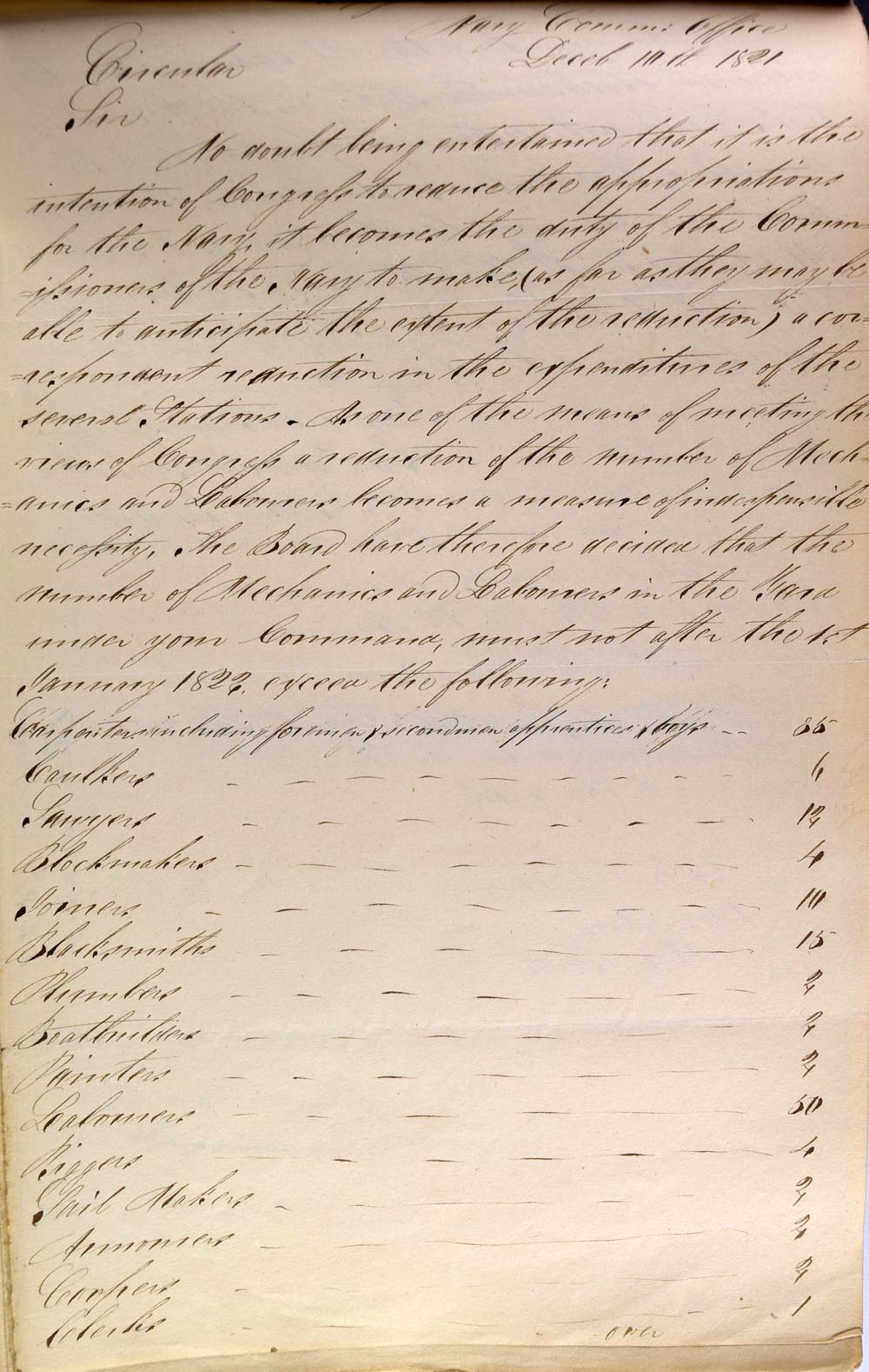
Source: Board of Navy Commissioners to Commodore Samuel Evans 10 December 1821 subject reduction of civilian employees IMAGE
Circular
Sir
No doubt being entertained that it is the intention of Congress to reduce the appropriation of the Navy, it becomes the duty of the Commissioners to make (as far as they may be able to anticipate the extent of the reduction) a corresponding reduction in the expenditures of the several Stations. As one means of meeting the view of Congress a reduction of the number of Mechanics and Laborers becomes a measure of indispendisble necessity, the Board have therefore decided that the number of Mechanics and Laborers in the Yard under your Command must not after the 1st of January 1822 exceed the following.Carpenters including foremen & secondmen, apprentices & boys … 55
Caulkers 6
Sawyers 12
Blockmakers 4
Joiners 10
Blacksmiths 15
Plumbers 2
Boatbuilders 4
Painters 4
Laborers 50
Riggers 4
Sail Makers 4
Armourers 4
Coopers 4
Clerk 1
If the number of the Mechanics than Carpenters and Blacksmiths stated in the preceeding list should not be found proportionate to the number of Carpenters & Blacksmiths, then an additional number may be retained, so as to make the Mechanics in all the other branches of business proportionate to the number of Ship Carpenters and Blacksmiths to be retained
I am very Respectfully Your most Obedient Servant
(Signed) John Rodgers
P.S. Should the number of Mechanics & Laborers authorized by the Board exceed the number which can be advantageously employed you will reduce them to number which can be employed with advantage to the public.
To: Capt. Samuel Evans
Navy Yard New YorkRegulations re Musters of Civilian Employees Naval Shipyard New York 1821
Source: Board of Navy Commissioners to Commodore Samuel Evans 31 January 1821 subject muster of civilian employees.40
40. National Archives and Records Administration, Washington DC, Records of the Department of the Navy Record Group 45.3 Records of the Board of Navy Commissioners, Letters Sent 1815 -1842 p. 21.
Naval regulations required a daily muster of all BNY employees. At musters employees were required to state their names as present for work to the Clerk of the Check. The Clerk of the Check was required to record each name present and absent on the daily muster rolls for pay purposes. Shipyard musters were usually conducted in the early morning and afternoon. For shipyard employees a failure to attend a muster was serious offense which could result in loss of pay or discharge. These 1821 regulations were sent by the Board of Navy Commissioners to Commandant Samuel Evan.
Circular no. 21 Navy Comm. - Office
31st Jany 1821Sir
The Commissioners of the Navy have found it expedient to adopt the following additional regulations with regard to the Musters &c of the different Navy Yards –
1st – A Lieutenant, if there be one attached to the Yard, or if not, the Sailing Master, is to be present at all Musters of the Mechanics and Laborers, which Lieutenant or Master is keep a regular Book or Roll, in addition to that kept by the Clerk of the Yard –
2nd To prevent Mistakes or fraud the Order of Muster must be as follows –
The rolls of the Lieutenants or Master, are to be made out in the same order as those of the clerk - The clerk is to call over the name of each Mechanic, Laborer, and other person employed by the day, in the order in which they stand on the rolls – and as they are so called, they are to pass in rotation in the presence of the said Lieutenant or Master, whose duty it will be to check any omissions or correct any mistakes, which may accidentally or otherwise be made by the Clerk
The roll being called [word crossed out illegible] The Lieutenant or Master is immediately afterwards to compare his Roll with that of the Clerk, in order to ascertain if they agree –
3rd At the end of each week the Clerk is to deposit his Roll signed by himself in the hands of the purser and Lieutenant or Master is in the like manner, to deposit his in the hands of the Commandant of the Yard, who before signing the general Monthly pay Roll (by which alone the purser will be authorized to pay the mechanics laborers, and others belonging to the yard & paid by the day) is to compare the rolls so kept by the Lieutenant or Master, with the monthly Pay roll made out by the purser, in order to satisfy himself, that their respective Rolls agree, before he the Commandant puts his Signature to that, by which the purser pays the Men –4th – The originals rolls kept by the Clerk, are on the settlement of the Pursers accounts with the 4th Auditor to be sent with such accounts as indispensable vouchers establishing the correctness of the Sums respectively paid to the mechanics, laborers and others employed by the day –
5th The Rolls kept by the Lieutenant or master, and deposited in the hands of the commandant of the yard, are those by which the Commandant is to make out the monthly rolls required to be sent to the Navy Commissioners Office, shewing the sums expended for labor on each and every object, whether for Navy Yards – repairs, Ordnance or gradual increase, or whatever object it may be; and in order to multiply the number of checks the commandant is to file and preserve all weekly rolls from which he makes out - the before mentioned monthly Rolls –
6th. – One day in every Week the Commandant will in person attend the Musters of the Yard and see that they are Conducted in manner herein prescribed –
Respectfully
Jno Rodgers – Pres
To: Murray, Evans, Hull, Morris, Tingey, CassinReduction in Pay
Source: 8 Dec 1821 BNC Commodore John Rodgers to Captain Samuel Evans, subject pay and hours of work. RG 125, Records of the Judge Advocate General Case Number 403 Capt. Samuel Evans Entry 26 – B.
Sir
The Commissioners of the Navy, considering that the days have become much shorter, that it is not possible for the Mechanics to do as much work as during the long summer days, have decided upon a reduction of their wages in several building yards, accordingly first rate Carpenters are to be reduced to $ 1.40 per day and the other mechanics proportionally from the 1st inst. You will be pleased to cause this reduction to be made in the Yard under your Command –
I am Sir Respectfully
Your most Obt. Servant
(Signed) John Rodgers
To Capt. Samuel Evans
New YorkReduction in Pay
Source: 4 Dec 1822 BNC Circular to Commodore Samuel Evans, subject pay and hours of work. (E307 v3).
4 Dec1822
Sir,
Because of the "shortness of the days and the impossibility of much work being done during the inclement season, Yards should reduce rolls to numbers as can be advantageously employed" and reduce pay by 10% in consultations with naval constructor, to begin 1 Jan through inclement weather .
I am Sir Respectfully
Your most Obt. Servant
(Signed) John Rodgers
To: Captain Samuel Evans
New YorkThe Carpenters and Blacksmiths "have left off work."
Source Samuel Evans to Commodore John Rodgers 10 December 1821 re Mechanics leaving over wage reduction. Court Martial of Samuel Evans, Record Group 125, Records of the Navy Judge Advocate, Entry 26B
U.S. Navy Yard
New York
Dec 10th 1821Sir
Sir, I have had the honor to receive your letter of the 3rd inst, directing that the wages of the first rate Carpenters, should be in consequence of the shortness of the days be reduced to $1.40 per day and the other Mechanics in proportion, which was communicated to them, and all the Carpenters employed excepting five, and all the Blacksmiths excepting two, have left off work this morning –
I have the honor to be
Very respectfully
(Signed) Samuel EvansTo: Commodore John Rodgers
Pres of the Board of Navy CommissionersThe Court Martial of Commodore Samuel Evans 1823
Source: Court Martial of Samuel Evans, Record Group 125, Records of the Navy Judge Advocate, Entry 26B
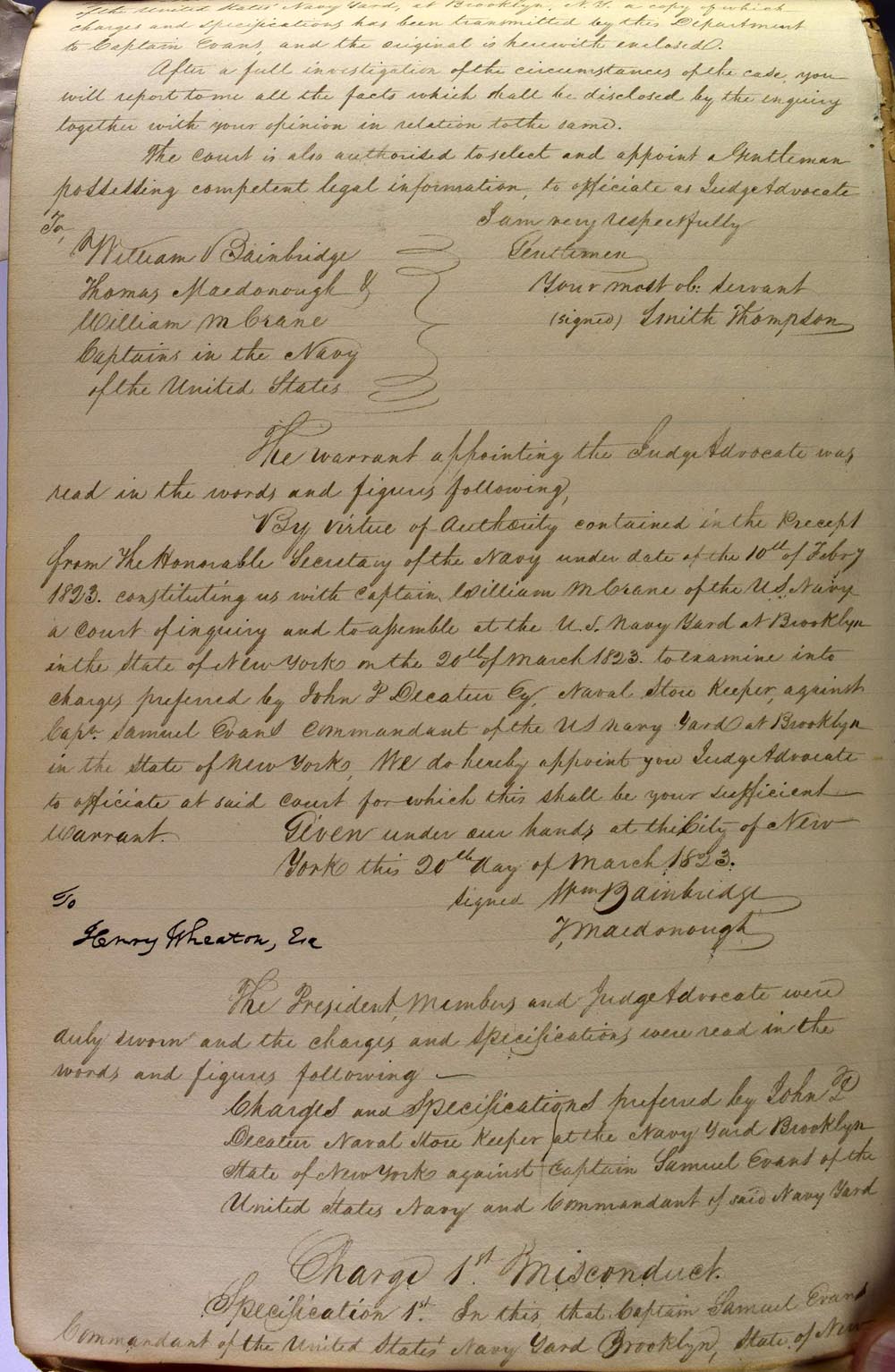
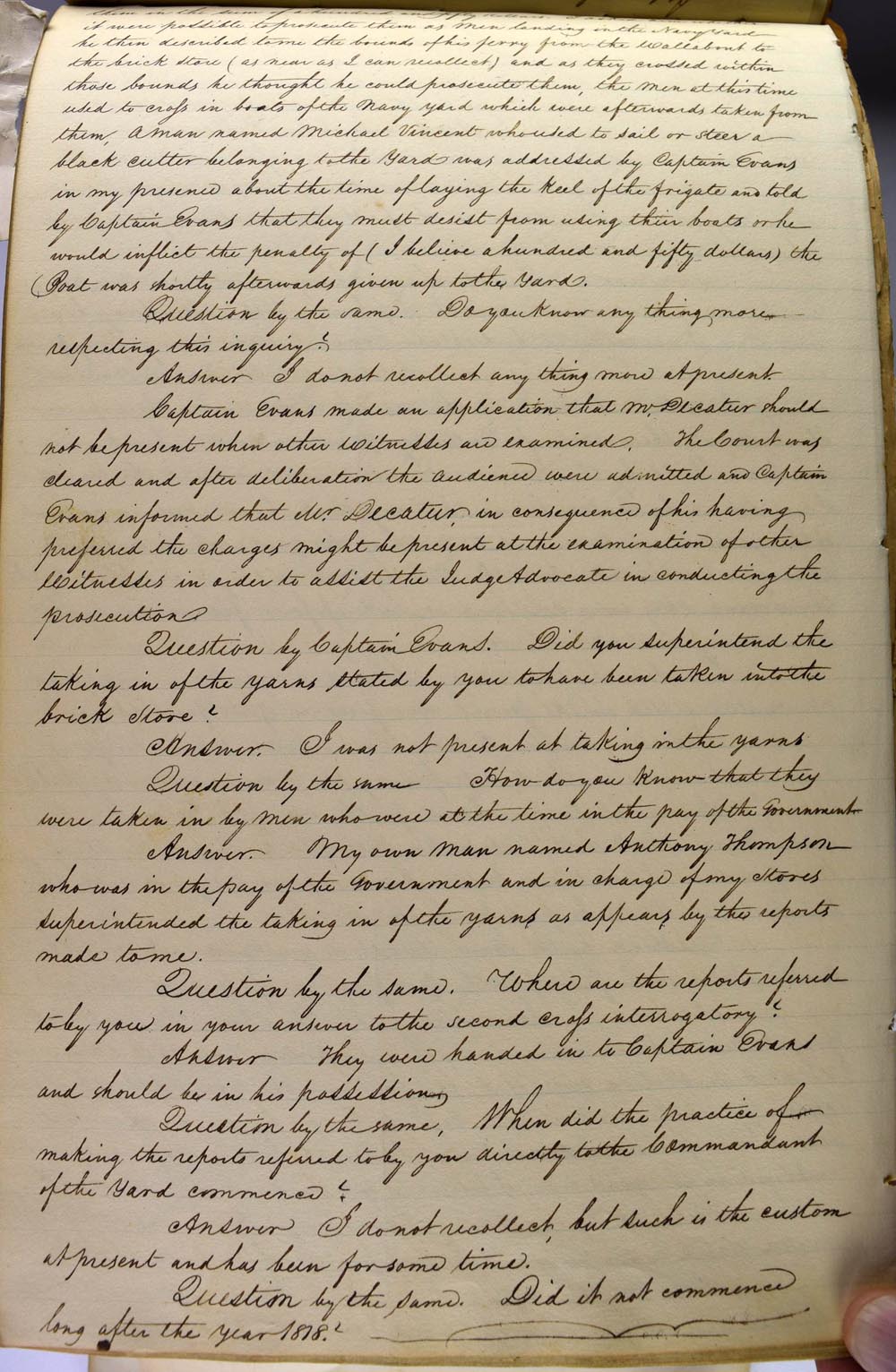
IMAGE 1 & IMAGE 2Commodore Samuel Evans 17?? to 1824 was the third BNY Commandant. Evans served as the Commandant 16 May 1813 to 2 June 1824. He was appointed as Midshipman 11 May 1798 and served in the Barbary Wars and the War of 1812. Evans was appointed Captain 4 July 1812. On 30 April 1813 he asked to be relieved of the command of the Chesapeake, stating his eyesight was affected as the result of an old wound, and he must be under the care of an oculist. On 6 May 1813 the Secretary replied to his letter, releasing him from his command of the Chesapeake, and ordered him to take command of BNY, 'to afford him a convenient situation while his health was restored,' stating that 'the service could but ill dispense with him,' and that at the New York Yard, then vacant, 'the services of a judicious, active, prudent and economical officer were extraordinarily wanted." Sadly, Samuel Evans tenure was mired by controversy.
On 27 March 1823 the New York Evening Post announced "A Naval Court of Enquiry is now sitting at the Navy Yard, Brooklyn, by order of the Secretary of the Navy to investigate the conduct of Evans, as commandant of the yard upon charges preferred by John P Decatur, Esquire naval storekeeper."41 As early as 12 August 1807 the location of the navy yard made Commodore Isaac Chauncey write to the Secretary of the Navy regarding a need for a reliable means of transportation between the BNY and New York City. The new navy yard site made for long delays in receiving personnel, supplies and limited the availability of potential workmen to those living nearby. Shortly after taking command Evans recognized the need for a commercial ferry and with a group of wealthy investors set about forming the Navy Yard Ferry Company. On 22 December 1817 the New York City Common Council granted Evans' company the franchise to run the ferry for the term of fifteen years "for the accommodation of mechanics and others in crossing."42 On July 17, 1818, the ferry began operations from Walnut Street, New York, to a location near the navy yard.43
On 4 June 1823 a local newspaper the National Advocate reported Commodore Evans, by order of the Secretary of the Navy, was assisting Joseph Graham by providing a berth at the navy yard for machinery to be used in raising the gold supposedly on sunken HMS Hussar (see Commodore Chauncey’s letter 15 June 1811). But it was Evans other business venture that quickly caused trouble and resulted in his court martial. His trial began in July of 1823. Most of the testimony heard by the court came from civilian employees. The charges, seventeen of which are listed below detailed numerous diversions of public stores and materials44 in the 24 August 1823 edition of Niles Weekly Register and 5 August 1823 of the New York Evening Post. These charges detailed numerous diversions of public stores and materials. This included the selling of government owned supplies and fittings to private shipping interests, the use of government owned small boats to operate a ferry service for Evans personal gain, and the building of a ferry boat for Evans private use with government labor and materials and the diversion of lumber and workmen to build additions to Evans home.45 Evans was convicted of "blending his public and private concerns" and officially reprimanded by the Secretary of the Navy. Evans died June 2, 1824, of a coronary aneurysm while boarding the ladder of the USS Constitution.46 Reports of the Evans trial were widely carried in local and national newspapers of the era. For "blending public and private concerns" Evans was sentenced to receive a reprimand from the Secretary of the Navy.47 Evans was widely thought to be suffering a "derangement."48 The Secretary later, possibly with Evans mental state in mind, reduced the reprimand to a warning. The trial and court testimony deeply divided the workforce for over two decades.41. Evening Post, New York, New York, March 27, 1823, p. 3.
42. Stiles, Herny R. A History of the City of Brooklyn including the Old Town the Town of Bushwick and Village of Brooklyn and the Village and City of Williamsburgh Voume III, Published by Subscription: Brooklyn, 1870 pp 562-563. 2nd quote Minutes of the Common Council of the City of New York, Volume IX 1784-1831, New York City Common Council; New York 1917, p. 377.
43. Evening Post New York, New York July 21, 1818, p. 1.
44. Valle, pp 226 -227.
45. Valle, James E. Rocks and Shoals Naval Discipline in the Age of Fighting Sail Naval Institute Press: Annapolis 1996, pp 226-227.
46. National Advocate New York June 2, 1824, p. 2.
47. New York American For the Country, New York 6, August 1823, p. 2.
48. Maloney, Linda M. The Captain from Connecticut the Life and Naval Times of Isaac Hull, Northeastern University Press: Boston 1986, p. 361.
Niles Weekly Register Volume 24 August 9, 1823, pp 360-363.
General Court Marshal
Navy Department July 30th 1823
At the request of Captain Samuel Evans ordered that the following proceeding can be publishedSmith Thompson
At the general naval court martial assembled and held on board the United States, ship Washington, at the navy yard at New York, on Tuesday the 10th of June 1823, was tried on the following charged and specification, viz
Charge – Misconduct
Specification 1st – In this, that Samuel Evans Esq. Captain in the navy of the United States, and commandant of the navy yard at Brooklyn, in the state of New York, having the charge and superintendence of the ships, magazines, stores, and other public property of the United States in and near the said navy yard, in the years 1818 and 1819, permitted the time and services of persons employed in the said navy yard, and then in the pay of the United States, to be used and employed in receiving and delivering hempen yarns not the property of the United States.
Specification 2nd - In this, that said Samuel Evans Esq. commandant as aforesaid did in the year 1820 take or suffer to be taken out of said navy yard, slab pieces, blocks of timber, roughage pieces and yellow pine edgings belonging to the United States and did permit the same to be applied to his private use.
Specification 3rd - In this, that said Samuel Evans Esq. commandant as aforesaid, did in the year 1820, take from the said yard sundry pieces of timber belonging to the United States and apply the same to his own use, returning the other pieces in exchange, but without keeping any accurate account of the quantity and quality of the pieces, respectively, so taken and returned, by which a proper estimate of their relative value could be made.
Specification 4th - In this, that said Samuel Evans Esq. commandant as aforesaid did in the spring of the year 1820 permit a piece of timber belonging to the United States to be taken from the said yard and made into a mast for a boat, the private property of the said commandant, by the mechanics of the said yard in the pay of the United States.
Specification 6th - In this that said Samuel Evans Esq. commandant as aforesaid did permit the time and services of several mechanics in the pay of the United States to be employed in the erection of a fence around the said ferry house the property of said commandant.
Specification 7th - In this that said Samuel Evans Esq. commandant as aforesaid, did in the year 1820 permit persons in the pay and employment of the United States to absent themselves from the navy yard to render services in razing a stable belonging to the said commandant.
Specification 8th - In this that said Samuel Evans Esq. commandant as aforesaid, did in the year 1820 permit oil, drying stuffs, paints and other materials belonging to the United States to be used on boats the property of the said commandant and the work on the same to be performed by persons in the pay of the United States.
Specification 9th - In this, that said Samuel Evans Esq. commandant as aforesaid, did in the year 1819, or 1820, take for his own private use eighteen blankets belonging to the United States, paying for the same only the price of the damaged and condemned blankets when it does not appear that those taken were of that description.
Specification 10th - In this that said Samuel Evans Esq. commandant as aforesaid did in the year 1819, [used] the time and services of a carpenter in the pay of the United States to be employed in making a pair of window shutters for a store, the property of the said commandant.
Specification 11th - In this that said Samuel Evans Esq. commandant as aforesaid did at different times permit persons in the pay of the United States to be employed in private jobbing boats, the property of the said commandant.
Specification 12th - In this that said Samuel Evans Esq. commandant as aforesaid did prior to the year 1817 permit horses, not belonging to the public, to be shod at the navy yard with public materials and by workmen in the pay of the United States.
Specification 13th - In this that said Samuel Evans Esq. commandant as aforesaid did at different times employ Cornelius Lafferty, the porter of the navy yard, and in the pay of the United States, as master of the ferry, the property of the said commandant.
Specification 14th - In this, that said Samuel Evans Esq. commandant as aforesaid, did since the year 1820, for his private emolument, throw obstructions in the way of the workmen crossing from New York in the navy yard, otherwise than in his own ferry boats, and arriving too late, by taking off the checks from the muster roll allowing them credit for full day’s work.
Specification 15th - In this that said Samuel Evans Esq. commandant as a foresaid did since the years 1820 and 1821, allow to workmen from New York, employed in the navy yard, greater wages than those of equal abilities, living in Brooklyn.
Specification 16th - In this that said Samuel Evans Esq. commandant as aforesaid did in the year 1817 permit the time and services of a person in the pay of the United States to be employed in hauling up timber, the property of said commandant.
Specification 17th - In this that said Samuel Evans Esq. commandant as aforesaid did and does still retain in the service of the United States, Thomas Ash, who was detected in 1822, in stealing tobacco, the property of the United States.
The court, having maturely and deliberately considered the testimony, and defense offered by the accused, as well in relation to the charge as to each specification, doth find in relation to the several and respective specifications as follows:
1st. As to the first specification, the court is of the opinion, and doth find, that in the year 1818, or 1819, the time and services of persons employed in the navy yard, mentioned in the specification, and then in the pay of the United States, were used and employed in receiving and delivering hempen yarns, not the property of the United States; but it is not proved that such use or employment of Captain Evans, except in relation to one of the said persons.
2nd. As to the second specification, the court is of the opinion, and finds that, in the year 1820 some articles of the description specified belonging to the United States, were taken from the navy yard, and were applied to Captain Evans own use, but does not appear from the evidence that Captain Evans had personal knowledge of the articles being so taken or that he knew of their being applied to his own use.
3rd. As to the third specification, the court is of the opinion, and find, that in the year 1820, sundry pieces of yellow pine edging of small value belonging to the United States were taken from the navy yard, and applied to the use of Captain Evans. The other pieces of white pine, supposed of equal value to those taken, were returned to the yard, but no account of the quantity or quality of the pieces taken or returned was kept. It was not proved that Captain Evans had any knowledge of this transaction. The court also finds that certain pieces of timber, such as posts and parts of boards and plank belonging to the United States were in the year 1820 taken by direction of Captain Evans from the navy yard and applied to his use in the making of a ferry house of his, on the York side of the East river, where he had a ferry to prevent accidents from passengers rushing into his ferry boats at the time the Ohio was launched. It is proved that these materials, or the greater part of them, were returned to the yard, but it does not appear that any account were taken of their quantity or quality was kept when they were taken or when they were returned. The court also finds that a topmast, which belonged to the United States which was in the yard, was sawed up and a part of applied to the use of Captain Evans as a pile in a dock of his at the before-mentioned ferry, which post has not been returned to the yard. It is not proved that Captain Evans had any knowledge of the topmast being so taken. Nor is it proved that any other timber, or other such materials is described in the third specification, taken from the yard was returned, than as above mentioned.
4th. as to the fourth specification - the court is of the opinion and does find that the facts thereby charged are proved.
5th. as to the fifth specification - the court is of the opinion that the facts therein charged are not proved.
6th. as to the sixth specification - the court is of the opinion that the facts therein charged are proved.
7th. As to the seventh specification - the court is of the opinion and finds that in the years 1820, persons in the pay and employment of the United States did absent themselves from the navy yard, and did render services in razing a stable for Captain Evans; but it did not prove Captain Evans that Captain Evans had knowledge of this transaction.
8th Specification – As to the eighth specification, the court is of the opinion and finds that it is not proved that Captain Evans did, in9th, 10th and 11th Specifications – As to the 9th, 10th and 11th specifications the court is of the opinion and finds that the facts charged in the said specifications are not proved.
12th Specification – As to the twelfth specification, the court is of the opinion and finds, prior to the year 1817, horses not belonging to the public were shod at the navy yard with public materials, and by workmen in the pay of the United States; but it is not proved that Captain Evans had knowledge of the fact previously to the before-mentioned period when he in very particular manner prohibited its being done.
13th Specification – As to the thirtieth specification, the court is of the opinion and finds, the facts therein charged are proved.
14th Specification – As to the fourteenth specification, the court is of the opinion and finds the facts therein charged are not proved.
15th Specification – As to the fifteenth specification, the court is of the opinion and finds the facts therein charged are proved.
16th Specification – As to the sixteenth specification, the court is of the opinion and finds the facts therein charged are not proved
17th Specification – As to the seventeenth specification, the court is of the opinion and finds the facts therein charged are proved; but the court thinks proper to state, that the offense of Ash was very light; the tobacco stolen by him was less than a pound, and not over three cents in value. That he is a man of a large family, and independent of the crime mentioned in the specification, he has always sustained a good character. That he was distinguished for industry and punctuality as a laborer in the yard. That upon detection of Ash being reported to captain Evans, he immediately instituted an enquiry into the circumstances of the crime, and while the investigation was depending, an appeal was made in favor of Ash by the clerk of the yard; and the court is of the opinion that Captain Evans, in retaining Ash in the service of the United States, has exercised a due discretion consistent with humanity, and not inconsistent with public duty.
The court considers that the matters they have found proven, constrains them to pronounce the accused guilty of misconduct, and they do convict him of the charge; yet they think it due to him to say, that it appears to them that he has been subjected to this charge by want of due care, circumspection and attention, and not by having acted from cupidity or culpable motives. The court having duly considered the premises is of the opinion, that as misconduct, the charge whereof they have convicted the accused is not a crime specified in any article of the act for better government of the navy of the United States, they can only sentence the accused under the thirty second article of the said act. The court does therefore pronounce the following sentence:
That the accused be reprimanded by the honorable the secretary of the navy, and be admonished by him, and that he the accused be more cautious not to blend his public and private concerns as he has done.A. SINCLAR, president
I. WARRINGTON,
MEL. T. WOOLSET,
JNO. ORDECREIGHTON,
JNO. DOWNES,
J. D. HENLEY,
CADWALLADER D. CULLEN
Judge Advocate.*
By the Secretary of the Navy
Although the court pronounced Captain Evans guilty of the charge of misconduct, yet, by the special findings applicable to the several specifications, it appears that, in every material instance where public materials or public labor has been applied to his benefit, it has been done without his knowledge. And the proceedings show that, even in these cases, an equivalent or a supposed equivalent, was returned: So that it could not be proven by persons who directed the same, has been a misapplication of public materials or public labor to his private benefit, with any fraudulent intent. It is not therefore to be inferred, from the judgment of the court, that the misconduct of which Captain Evans is found guilty, implies criminality - and that such must have been the understanding of the court, is evident, because they say expressly that he has been subject to this charge by want of due care, circumspection and attention, and not by having acted from cupidity or culpable motives. And this construction of the meaning and intention of the court is fortified by the consideration that, even admitting fraud in the agents of Captain Evans, this could not subject him to any criminal charge. He could be so far responsible for their acts as to be bound to restore an equivalent for the materials or labor applied to his benefit; but, if he was ignorant of the fact or disapproved of it, and forbade a repetition when known (as it appears he did in the only case that came to his knowledge), no crime could be imputed to him. The only misconduct then imputed to Captain Evans, by the judgement of the court, and which in my opinion is all the testimony would warrant, is the want of due care, circumspection and attention, to prevent the application of public materials and labor to his private benefit. I have thought proper to give this explanation of my understanding of the judgement of the court in my approval of the proceeding, and which becomes necessary for the purpose of determining the nature and extent of the reprimand, which by the sentence of the court, I am required to give Captain Evans. Believing as I do, that no unworthy or dishonorable motive ought to impeach his honor or integrity as an officer, the only admonition called for by this case, is I think, that he be more cautious about blending his public and private concerns. I take this occasion, however, to observe as a general rule that I cannot approve of commandants of our navy yards being engaged in private business that leads in any measure to a blending of public and private concerns; for with the most scrupulous honesty and stern integrity it is difficult, if not impracticable, to guard against unworthy jealousies and suspicions, which may be prove injurious both of the character of the officer and the service.SMITH THOMPSON
Navy Department, 8th July 1823,
Ordered that the foregoing be sent to Captain Evans, in execution of the sentence of the court martial. S.T.James Fennimore Cooper visits the Brooklyn Navy Yard
Source: Western Carolinian, Salisbury, North Carolina, August 31, 1825, p. 3.
On Thursday, 5th, the officers station at New York Navy Yard, gave a dinner to the celebrated American Novelist, JAMES COOPER, Esq., formerly an officer of the Navy.
Apprentice Indentures: BNY was for nearly a century New York City’s largest employer with a large numbers of trade apprentices working at the navy yard. Early naval regulations allowed master mechanics wide discretion as to the hiring and training of their apprentices. Naval regulations did specify the minimum age of apprentices, the specific number of apprentices each master mechanic might hire and the wage rates for apprentice labor. While indentured apprentices were paid by Department of the Navy and they were in every sense the apprentice of a specific master mechanic. New York City like most major eastern cities required a signed indenture or contract specifying the duties and responsibilities of both parties in some detail. Originally both parties to such indentures received a signed copy of the document while another was made for the municipal records.
Apprentice indentures and related documents are genealogical gold mines for they provide historians considerable detail about the lives of ordinary people. An apprentice indenture was foremost a legal contract between the apprentice and the master mechanic. The Department of the Navy was not a party to these contracts nor bound by their stipulations. The typical apprentice indenture lists the apprentice name, parents or guardian’s names if a minor, age of the apprentice, some others provide birthdates and place of birth etc. The documents also reflect the level of literacy of the apprentice and parents. Where the individual was unable to write his or her name, the documents are marked with an X and witnessed by literate adults. In the early United States the formal apprenticing of children was the method used for nearly two hundred years to train the young for useful occupations. The apprenticeship system of New York City provided for formal indentures or contracts in which young people were legally bound to labor for a set number of years in given trade or occupation, and in return for their service they would receive trade or occupation instruction and tutelage from their master. While most apprentices entered into their apprenticeship voluntarily with the consent of their parents, some other young people (orphans and poor children) were placed unwillingly while others, from dislike of their chosen trade or more often disagreements with their master, ran away. Perhaps the most famous of these runaways was Benjamin Franklin who broke his indentures by running away from his brother James in 1723 for New York City. Since the apprenticeship was a legal contract between the master and the apprentice, the law gave the master the right to take action to recover errant apprentices, and if necessary take the apprentice by force. The New York Historical Society http://dlib.nyu.edu/findingaids/html/nyhs/indentures/dscref15.html collections contains many examples of over two centuries of apprentice indentures. Brooklyn on Line has posted "Historic Greepoint" by William L. Felter 1915 http://bbs.brooklynonline.com/history/greenpoint-brooklyn-history.xhtml which has a good example and brief discussion of an apprentice indenture.Canadian born Donald McKay 1810-1880 began his famous career as ship designer in New York City as carpenter apprentice. McKay’s 1827 indenture as a ship carpenter apprentice is a good example of typical nineteenth century apprentice contract.
Source: McKay, Richard C. Donald McKay and His Famous Sailing Ships Dover Publications: New York, 1995, pp. 5-7.
APPRENTICE INDENTURE: Donald McKay to Isaac Webb 24 March 1827
This Indenture Witnessed, that Donald McKay, now aged sixteen years, five months and twenty days, and with the consent of Hugh McKay, his father, hath put himself, and by these presents apprentice to Isaac Webb, of the City of New York, ship–carpenter, to learn the art, trade and the mystery of ship-carpenter, and after the manner of an apprentice to serve from day of the date hereof, for and during and until the full end and term of four years, six months and eleven days next ensuing; during all of which time the said apprentice his master faithfully shall save, his secrets keep, his lawful commands everywhere readily obey; he shall not waste his masters goods, nor lend them unlawfully to any; he shall not contract matrimony within the said term; at cards, dice, or any other unlawful game he shall not play, whereby his said master may have damage; with his own goods nor the goods of others without license of from his said master he shall neither buy nor sell; he shall not absent himself without leave day nor night from his masters service without leave; nor haunt ale-houses, taverns, dance-houses or play houses; but in all things behave himself as a faithful apprentice ought to do during said term. And the said master shall use the utmost of his endeavors to teach or cause to be taught or instructed the said apprentice in the trade or mystery of a ship-carpenter, and the said master shall pay to the said apprentice the sum of two dollars and fifty cents weekly for each and every week he shall faithfully serve him in the said term. An shall also pay to him the sum of forty dollars per year, payable quarterly, for each and every of the said years, which is in lieu of meat, drink washing, lodging, clothing and other necessaries. And for the true performance of all and singular covenants and agreements aforesaid, the said parties bind themselves each unto the other firmly by these Presents. In Witness Thereof, the party to these Presents have hereunto set their hands and seals the 24th day of March, in the year of our Lord one thousand eight hundred and twenty-seven.
Isaac Webb {SEAL}
Donald Webb {SEAL}
Hugh Webb {SEAL}Recorded the 24nd day of March 1827
[end document]
Explosion of the Steam Frigate Fulton
Source: Republican Compiler Gettysburg Pennsylvania, 5 June 1829
On 9 March 1814, Congress authorized the construction of a steam warship to be designed by Robert Fulton, a pioneer of commercial steamers in North America. The construction of the ship began on 20 June 1814 at the civilian yard of Adam and Noah Brown, and the ship was launched on 29 October. After sea trials she was delivered to the United States Navy in June 1816. The ship was never formally named. Fulton christened it Demologos though following his death in February 1815 the ship was named Fulton.
By the time she was completed, the war for which Demologos had been built had ended. She saw only one day of active service, when she carried President James Monroe on a tour of New York Harbor. A two-masted lateen rig was added by the orders of her first commander, Captain David Porter. In 1821 her armament and machinery were removed. The remainder of her career was spent laid up in reserve; after 1825 she served as the floating barracks for Brooklyn Navy Yard. She came to an end on 4 June 1829 in a gunpowder explosion.
Yesterday afternoon, about half past 2 o’clock, the Magazine of the steam frigate Fulton the First, which was lying on the flats about a cable’s length from the Navy Yard dock, exploded and dreadful to relate, killed and maimed nearly all on board, estimated from 70 to a hundred.
At half past 5 in the afternoon, 25 dead bodies had been brought on shore, and 25 to 30 of the wounded, many of whom are shockingly mangled. Others were yet missing. Among the dead were two women, wives or relatives of the marines and seamen. The magazine was directly under the sick bay and all the invalids there confined, supposed about 15 in number, were killed. The officers on board were Lieut. Breckenridge, who was so badly wounded that it was feared he could not survive many hours. His lady, who was on board at the time, was slightly wounded.
Lieut. Platt, badly wounded.
Lieut. Mull, slightly wounded.
Sailing Master Clough, badly wounded.
Midshipmen - Eckford, leg broken in two places; Johnson, badly wounded; Hoban, slightly.
The accident is supposed to have occurred in consequence of the ignorance of a person named Williams who was employed yesterday to act as gunner, who it is said, went into the magazine with a light, mistaking the place for another apartment. There was but a small quantity of powder in the magazine, caused no greater concussion than the firing of a 44 pounder; yet the three masts of the frigate were blown into the air to the height of 40 to 50 feet, both decks forward of the main mast blown up, the starboard side shattered to pieces and the ship rendered a complete wreck. Com. Chauncey and Capt. Newton, the commander, with several other persons, left the ship a few minutes before the explosion. The band of musicians and the laborers employed were fortunately on shore at the time. There were fewer persons on board than usual and the number we have stated above may be exaggerated. Some of the officers estimate the number at not more than sixty or seventy. About 60 marines left the vessel on Wednesday to proceed for Norfolk and a like number a day or two before. The officers on board were at dinner when the explosion took place. The Coroner of this city held inquest on the bodies of the following persons: R. M. Peck, Wm. Peck, Alexander Cameron, Mrs. Nelson, Mrs. Williamson (colored woman), James Livingston, Thomas Walton, Harmon Vatel, Wm. Brown, Franklin Ely, Wm. Stockwell, Henry Lovan, Peter Gilen, John Brown, John McKennen, Jacob Boise, Chares Williamson, James C. Burgher, Otto E. Fergentine, Silvanus C. Hallaran, Henry Megrew, John Dilo Ravez, James Pierce, Lieutenant Breckenridge.
The inquest then adjourned and three dead bodies remaining to be examined - names not ascertained. When we left the Navy Yard at 11 o’clock only five men were unaccounted for. These have doubtless perished either by drowning or by being crushed among the timbers.Dry Dock Rumors
Source: Evening Star, New York, New York, 21 July 1835, p. 2.
There is a rumor afloat, but not traceable, that the Secretary of the Navy has decided to erect a Dry Dock at Governor’s Island, if there is a suitable location for erecting a dry dock.
*
Source: November 16, 1835, Evening Post, New York p. 2.
Note: early in the fall of 1835, the mechanics in the Brooklyn Navy Yard petitioned the Secretary of the Navy and the Board of Navy Commissioners to reduce their work hours from twelve to ten. Even ten years after Samuel Evans court martial, the workforce remained deeply divided. In their report, the workers stated the case for the ten hour day and listed other grievances. Chief among their complaints was that Commodore Evans had blacklisted workers who testified against him at his 1823 court marital and that later the Department of the Navy had bared men who had advocated for a ten hour day from employment at all naval shipyards.
Report of the Committee of Shipwrights, Smiths, Joiners and other citizen Mechanics of the Brooklyn Navy Yard
Part of the report of the Committee appointed at a meeting of Shipwrights, Smiths, Joiners and other citizen mechanics of New York and Brooklyn, September 9, 1835, and instructed to inquire into certain practices injurious to the rights and interest of the citizens said to be allowed in the Navy Yard, Brooklyn, read and accepted at a meeting, October 23, 1835.The Committee aforesaid has the honor to report, that they have made inquiries directed by the meeting and find that William Wells, Augustus Butler, Michael Coulfield, Amos Dickerson, and other apprentices in the blacksmith’s department of the Brooklyn navy yard have received higher wages than the journeymen, more than three fifths thereof going to Samuel Hill master blacksmith, who by such addition to his pay of $3 per day is believed to receive $2500 a year on the apprentices coming of age, such extra wages ceased for instance, John Dickerson who served an apprenticeship in the blacksmith’s department, worked elsewhere after he was of age, and was of excellent character; for skill and industry, and moral worth, was rated below his younger and less athletic brother Amos Dickerson an apprentice. In the joiners department, Francis Cecil. John Ross, Smith Whaley, William Lee, Romeo Freganza, William Owens, Abraham Bloodgood, John Dickie, John Woodward, Caleb Harvey paid part of their wages to James Dubois, master joiner, and were allowed to misspend their time in a scandalous manner. The committee have reason to believe when the yard was under the command of Isaac Chauncey, that William Van Voohis, Daniel Potter, Benjamin Delano, George Hall, Edward Delans, William Williamson, Michael Webb, John Moore, William Vincent, John Midwinter, Isaac Rollins, Alfred Rollins, John Green, Richard Hall, John Creal, and others, paid the third of their wages to Samuel Hartt, the Naval Constructor, whose salary is $2, 300 a year.
As the persons having the charge of the publick work are paid for their time at a rate which would command the services of better men, it is the publick that gives instruction to the apprentice; and to compel him to pay part of his wages to one who does nothing therefor, appears to be under the revolting violation of the right of the citizen to his own labor – a right inalienable in itself and inseparable from the "right of life, liberty and the pursuit of happiness." No less at variance with the institutions of the republic, which should enforce the return of service and duty according to the privileges and protection bestowed, is this taxing the scanty and insufficient wages of the laborer to increase the riches of the selfish and unprincipled master.
It may be asked from whence the government derived the right to interfere in the pursuits of private life, to take apprentices to ordinary trades and callings, and to turn them out inferior workmen to underwork and injure honest citizens in their means of living. Is it providing for the common defense and general welfare to displace from the public works able and faithful workmen, sons of soldiers of the revolution, to make rooms for boys and British aliens, whose wages are taxed to enrich an ignorant and unworthy master.
Your Committee believes it a most unfortunate and unjustifiable measure which placed the citizens who labor on the publick works under the control of persons amenable to military authority, Capt. Samuel Evans convicted by court martial on six of a hundred charges of embezzlement and conversion of publick property to private use, was restored to command of the Brooklyn Navy Yard, while certain citizens who on compulsory process, testified at his trial were excluded from employment therein during his life time (notwithstanding personal application made to John Rodgers, President of the Navy Board) and only admitted after his death, at the instance of the late Mr. Eckford. That Evans was not declared guilty on the remaining 94 charges will surprise no one when it is known that a workman, who by personal orders of Evans, had carried the publick material from the Navy Yard to mend a private fence, was privately examined thereon by the Judge Advocate, called immediately before the Court, sworn to give true answers to such questions as should be asked, and no one was asked which had the least relation to such personal orders; and it was said that Evans personal knowledge of the abstractions and conversions of publick property to his private use was not proved. No less criminal have been held who, following settled usage of the mechanics, have struck for time or wages; and John Knapp, and several others who stuck at Norfolk yard, were posted on the black list at Brooklyn; and so much is this proscription dreaded, that few workmen in the Navy Yard were willing to sign a memorial asking for the ten hour system so much desired by every working man in the nation. Immediately after the meeting of the 9th September, a note was sent to the head joiner of the Brooklyn yard forbidding the employment on the publick work of several citizens therein named, and suspected of being in said meeting, and the only workmen in the yard who ventured to attend was immediately discharged.500 Laborers Discharged
Source Sentinel of Freedom; Newark, New Jersey, February 27, 1838, 2.
More than 500 laborers have been lately discharged from the Brooklyn Navy Yard in the inclemency of the winter. It is stated by them that more than half of them have been unnecessarily discharged. The "Brooklyn Soup House Association,’ daily distributes charity to hundreds of the sufferers thus abandoned to the rigors of winter - Again, we would ask what has this people – worshipping Administrations done for the poor? Was their condition ever so bad under any Administration?
Commodore Charles Goodwin Ridgeley (1784 – 8 February 1848) served as Commandant 10 June 1833 to 19 November 1839. Ridgeley was born in Baltimore, Maryland. He served with Edward Preble during the First Barbary War. He was promoted to captain on 28 February 1815 and placed in command of Erie. He commanded the Brazil Station from 1840 to 1842. The following letters illustrate how master mechanics and senior civilians pay considered.
New York New York March 21st 1836
[Addressed to Commodore Charles G. Ridgely]Sir
I hope you will pardon my again intruding upon your valuable time which nothing but a sense of duty to myself and family would induce me to do, but situated as I am and having a family to support under the present exorbitant prices for provisions and house rent, I cannot but hope it will meet your favorable notice and induce the Commissioners of the Navy to increase my pay –
While all the other Master Mechanics of the Yard have had their pay increased - mine has remained. If I was unable to meet the expenses of my family I would not there trouble you - but I find with all economy I can use after schooling my children, paying house rent &c which later has increased at least one third the present year, that in lieu of laying aside a little money for sickness or causalities, I am involving myself in debt.
There is hardly a mechanic of any description Sir in Brooklyn or New York employed at day’s work who does not receive compensation equal to mine and many cases more.
Your kindly aid in my behalf will much oblige your very obt servant.
[Signed] Theoph Hardenbrook 4949. Brooklyn Daily Eagle 28 September 1850 "HARDENBROOK. -- In Brooklyn, on Friday morning, Sept. 28, suddenly, of disease of the heart, Col. THEOPHILUS HARDENBROOK, aged 69 years, 11 months and 12 days. Col. H. was a native of the City of New York, and for the last forty years, and up to time of his decease, held the position of Master Cooper of the Brooklyn Navy Yard, respected for his strict attention to duty and the faithful discharge of the trust confided to him. His friends and acquaintances, the members of the Veteran Corps of the War of 1812, and the Masonic fraternity, are respectfully invited to attend his funeral, from his late residence, No. 118 Sands St., Brooklyn, at 2 o'clock, P.M., on Sunday, Sept. 30. His remains will be conveyed to Greenwood Cemetery for interment." Theophilus Hardenbrook is buried at Green Wood Cemetery, Brooklyn, New York http://www.findagrave.com/cgi-bin/fg.cgi?page=gr&GRid=108612895
U.S.N. Yard N. York
March 24th 1836Sir,
I want most respectfully by leave to call your attention to the subject of my pay as Master Joiner of this Yard. It would be needless to enumerate to you the exorbitant prices which are required for house rent, provisions, &c &c as you must be perfectly aware of these circumstances. The increasing wages paid to mechanics of all descriptions added to the enormous expenses attending a resident near this navy yard lead me to believe that you will not hesitate to take such steps as will obtain a fair and liberal compensation for the situation which I have the honor of holding at this yard.
Mr. Harte has kindly consented to this mode of making known my wishes, and I have to request that you, when at Washington (which place I have heard you propose to visit shortly) lay the matter before the Board of Navy Commissioners –
I have the Honor to be your most obedient Servant
[Signed] James Dubois[Note] Dubois should have the increase of pay. C.G. R.
The Great Fire of 1835: Modern scholars believe the great New York City fire that began on the evening of 16 December 1835 started in a five-story warehouse at 25 Merchant Street, now known as Beaver Street, at the intersection of Hanover Square, Manhattan and Wall Street. As the fire spread, gale-force winds blowing from the northwest towards the East River spread the flames. At the time of the fire, major water sources including the East River and the Hudson River were frozen solid in temperatures as low as -17 °F (-27 °C). The resulting conflagration was visible from Philadelphia, approximately 80 miles away.50
50. Burows, Edwin G. and Wallace, Mike Gotham A History of New York to 1898, New York, Oxford University Press, 1899, pp. 596 -597.
Firefighters were forced to drill holes through ice to access water, which later froze in the hoses and pipes. Attempts were made to deprive the fire of fuel by demolishing surrounding buildings, but at first there was insufficient gunpowder in Manhattan. Later in the evening, New York Mayor Lawrence dispatched Charles King, editor of the New York American, to BNY to request for sailors and soldiers to do demolition and for the necessary gun powder. Marines and sailors from BNY led by Commodore Isaac Chauncey returned with gunpowder and began to blow up buildings in the fire's path. Subsequent investigation did not assign blame but reported that a burst gas pipe, ignited by a coal stove was the initial source. The following account of the fire was first reported in the New York Journal of Commerce 18 December 1835.
NEW YORK IN RUINS UPWARDS OF SEVEN HUNDRED BUILDINGS AND FROM TWENTY TO THIRTY MILLIONS IN PROPERTY DESTROYED
The night of Wednesday Dec. 16th will be long remembered as the date of the most destructive conflagration which ever took place in this city or on the American continent. The fire originated in the store of Comstock and Andrews, 25 Merchant Street and 131 Pearl. The wind being fresh from the westward, half a dozen stores were in blaze in a few minutes. Add to this the fireman being exhausted by the service of the previous night and day and their hose so much frozen that the raging element was unavoidably permitted to roll on unobstructed until it gained such tremendous power that resistance was became entirely useless. Store after store and block after block was swept down with astonishing rapidity. ----- The burning of the Merchant Exchange removed all hope that the fire could be stopped before reaching William Street, sweeping down on Exchange Place to the Scotch Dutch Church….This venerable pile was but sport to the flames – in less than half an hour the steeple fell and the whole building was destroyed except the walls. In the rear of the church towards Wall Street, was the printing office of the Journal of Commerce, from which warned by bitter experience of others, we removed everything moveable. The near proximity of the church together with the fact that no aid could be afforded by the firemen at this point prepared us to accept a similar fate with hundreds of our fellow citizens. But as good luck would have it there were a half dozen hogsheads of fine wine vinegar at the rear of our lot, some of which by consent of the owner, Mr. N.M. Brown were broached by the head and their contents together with a few pails of water which happened to be in the office and were applied so successfully to the exposed part of the office and another building similarly situated that both were preserved. This operation however was not unattended with danger, the blazing cornice being liable at any moment and the heat being sufficiently intense. By this one feat with pails and vinegar, we were able to save at least one million dollars from destruction, since if our printing office was gone nothing could arrest the progress of the flames until they reached Broad Street. Mr. Brown and Mr. Downing, the colored oyster dealers, deserve special commendation for their exercise at this point. Meanwhile the flames had extended in the opposite direction to the East River, a distance we should say of at least a quarter of a mile and were still raging on the south side of the Exchange Place, and extending West in Pearl, Water Front and South Streets. At this time Commodore Chauncey with a company of Marines arrived from the Navy Yard at Brooklyn and with the concurrence of the authorities blew up three or four buildings at different points where the flames were extending which materially aided in finally arresting their progress. The fire commenced about 9 o’clock on Wednesday evening and raged with unabated violence for at least EIGHT HOURS; and in one or two localities they were not fairly got under until 12 o’clock on Thursday noon or FIFTEEN HOURS from the time it broke out.
U.S. Navy Yard New York
December 24th 1835Sir,
Influenced by the extreme pressure of the times, occasioned by the unprecedented high prices of every necessity of life in this section of the country, I respectfully lay before you this application, trusting that if it is in your power, you will grant the request, I feel embolden to make. For many years I have filled the Station of Master Plumber of this Yard, and in performance of my duties feel that I have done that which was required of me to the perfect satisfaction of those under whose superintendence I have been placed. I have in addition to plumbing work done that also which properly belongs to a Tinsman to a Coppersmith and to a Sheet Iron Worker, thereby uniting four separate branches in our department, and as wages given to all mechanics at this period, are much advanced beyond the former rates owning to the excessive high prices of provisions &c and that on account thereof the Navy Commissioners have been pleased to advance the pay of several of the Master Workman of this Yard. I trust that you will take my case into consideration and grant such an increase under the circumstances.I am Sir very Respectfully Your Obt
Servt.
[Signed] William J. Boyer Master Plumber
To: Commodore Charles J. Ridgley Commanding Naval New YorkThe Ten Hour Work Day
Background: Work hours in the early United States were dawn to dust, in essence a twelve hour day based on the needs of farming and agriculture. Early in 1835 shipyard workers in the urban port cities of New York, Philadelphia, Boston and Washington DC were petitioning and agitating for a change in work hours.51 In New York City workers had achieved success with private shipyards but BNY employees were still working the same long hours. In December 1835 Commandant Charles Goodwin Ridgeley received the Board of Navy Commissioners (BNC) circular directing a ten hour day at the New York shipyard.
51. Roediger, David E and Foner, Phillip S In Our Own Time A History of American Labor and Working Day Greenwood Press: Westport, 1989, p. 38.
This BNC decision was prompted by events at Philadelphia Naval Yard. Commodore James Barron had written to the BNC about his attempts to resolve demands from Philadelphia shipwrights for changes in working hours. The shipwrights wanted the Department of the Navy to shorten their workday from 12 to 10 hours.52 The fight for a shorter workday in the United States began in the late eighteenth century, even before the establishment of the first trade unions. The worker’s goal was the ten hour day with no reduction in pay. A key aspect of this campaign concerned the way organizers framed their demand. They argued a ten hour day was needed not only to protect the health of workers, but also because the long and exhausting workday was a barrier to more revolutionary change. A circular issued in 1835 by Boston shipyard employees advocating the ten hour day, highlights the connection, "We have been too long subjected to the odious, cruel, unjust and tyrannical system which compels the operative mechanic to exhaust his physical and mental powers. We have rights and duties to perform as American citizens and members of society, which forbid us to dispose of more than ten hours for a day’s work." The Philadelphia Navy Yard strike was part of a large number of labor actions that took place in the summer of 1835 and the first successful action against the federal government. This BNC circular is dated August 26, 1835, and is addressed to federal shipyards commandants; the circular is a direct response to worker agitation and political pressure. This was also the first ruling by the federal government to mandate a ten hour work day and a milestone in labor history.53
52. The Struggle to Win the Ten Hour Workday in Philadelphia Navy Yard see Sharp, John G http://genealogytrails.com/penn/philadelphia/phlbios_a-b.html accessed November 24, 2016
53. The 10-Hour Day in the Philadelphia Navy Yard, 1835-36, O. L. Harvey Monthly Labor Review Vol. 85, No. 3 (MARCH 1962), pp.
Wednesday 26th Aug. 1835 [Board of Navy Commissioners]
To: Comm James Barron upon the subject of the working hours established by the circular of this date.
Circulars to Commandants: Wm. M. Crane, John Downes, Ch. Ridgeley, James Barron, Isaac Hull, L. Warrington & W. Chauncey. By Circular of this date, established the working hours of mechanics in different Navy Yards.
Memoranda Basis of Working Hours.
Memoranda: Length of Days at Washington
November, December, January & February: to commence work 45 minutes after Sunrise & have one hour to dinner will leave as a mean 8:05 for labor between Sunrise & Sunset. March to 15th April & Sept to end of October, an hour to breakfast & an hour to dinner, gives 9:47 for working time.
From 15th April to end of May & from 15 Aug to 15 Sept, an hour to breakfast & hour to dinner, will give 11:28 for working time.
June & July & half August, one hour for breakfast & 2 hours for dinner, gives 11:29 for the working hours.
The mean of the working hours for the year will be 9:53 for Washington.
[End Document]