Historical Reminiscing with Robert B. Hitchings
The Country Called Liberia in Africa
A few weeks ago I came across a fascinating article in the Norfolk Portsmouth Herald dated June 1, 1835. A free person of color named Beverley Wilson, a native of our area, had just returned from the country of Liberia and was bringing the latest news from this newly developed colony in Africa.
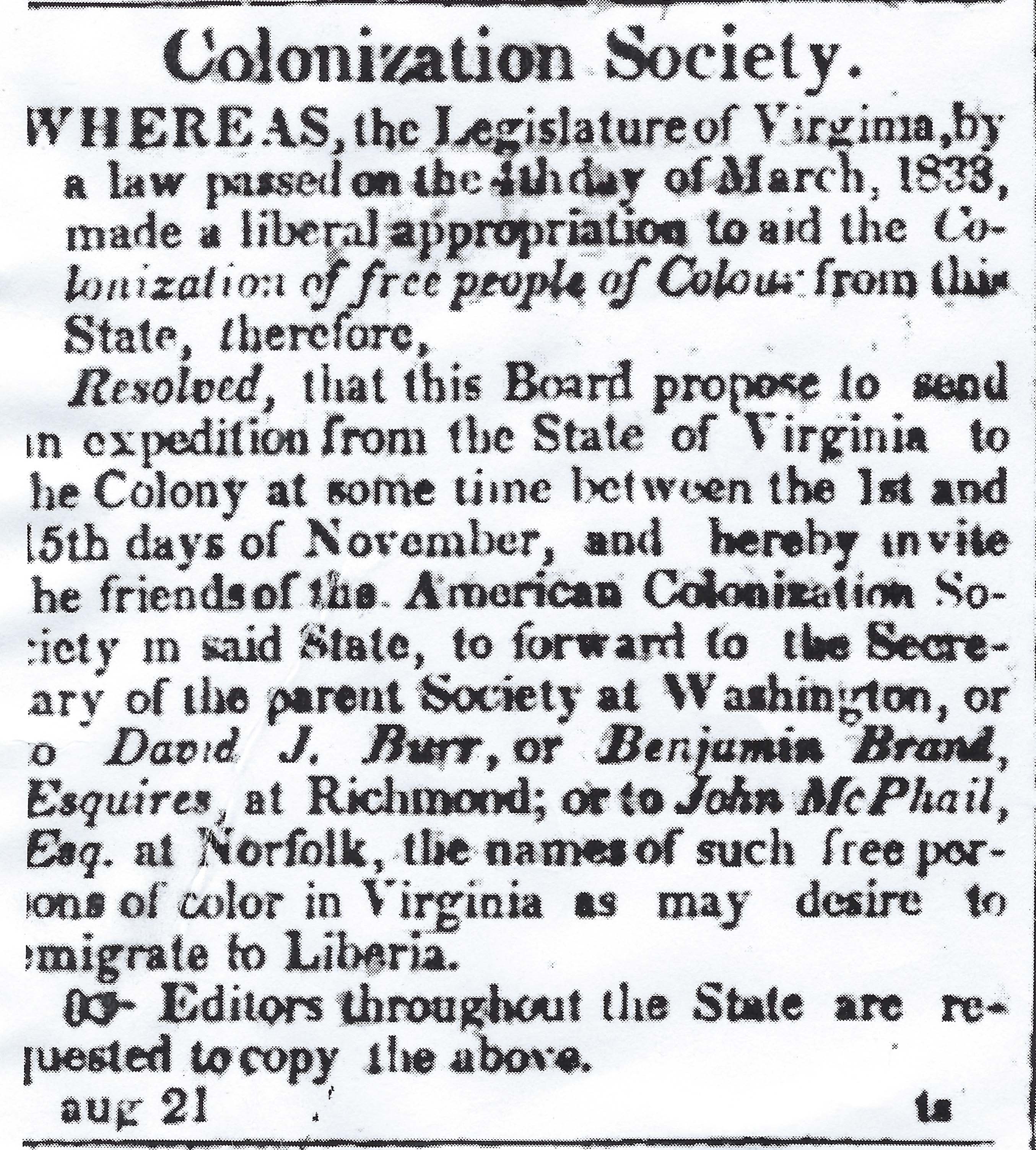
Liberia is a country in West Africa founded by free people of color from the United States. The emigration of African Americans, both freeborn and recently emancipated, was funded and organized by the American Colonization Society of America.
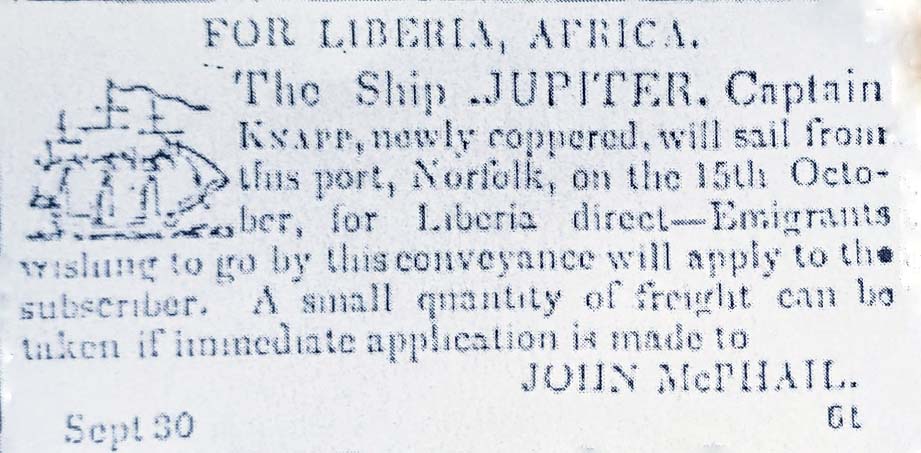
According to the article, he went to Liberia about 18 months ago on the ship Jupiter for the express purpose and interest of seeing the new state in Africa. He stayed there for about 11 months. According to the article Beverly Wilson was very pleased in what he observed and had returned to Norfolk to take his family there.
The American Colonization Society (ACS) was started in 1816 by a Presbyterian minister, Rev. Robert Finley (1772-1817) with prominent figures like Henry Clay (1777-1832), Francis Scott Key (1779-1843), and Bushrod Washington (1761-1829), nephew of George Washington, joining him to form an organization which aimed to resettle free blacks to Africa. They did not feel that these free black individuals could integrate in our society at the time. Rev. Finley conceived the idea of sending free blacks to Africa as being charitable and beneficial for free black community. One thing that drove these men to come up with this idea was a chance that black folks could escape the harsh treatment of racism and build a nation of its own.
On January 7, 1822, a ship took a few settlers to Dazoe Island, now called Providence Island, at the mouth of the large river called Mesurado. The settlers went ashore and established a settlement called Christopolis. In 1824 this city was renamed Monrovia after James Monroe, the 5th President of the United States. President Monroe was a prominent supporter of creating this colony in Africa for African Americans. He also believed this would combat the Atlantic slave trade. President Monroe would later sign into law the Anti-Slave Act of 1819 which funded the America Colonization Society to create this colony in West Africa. And we cannot forget in 1846 when Liberia declared its independence, and the newly elected first president was a Joseph Jenkins Roberts (1809-1876) of Norfolk, Virginia. He and his wife and child Sarah immigrated to Liberia in 1828.
According to the newspaper article, Beverly Wilson found the town of Monrovia quite interesting and a flourishing place containing about fifteen hundred inhabitants with five houses of worship, one Presbyterian, two Baptist, two Methodist, caring on a propitious little trade with the natives and other foreign vessels which are always in sight, chiefly the French and English. He describes the houses as plain but decently built and some of the new ones were even rather handsome. It is in fact, he says, “a prettier place to look at than our Smithfield,” (which we know is one of the prettiest villages we have) especially as it has the advantage of a fine bay with many ships in the harbor.
He went onto say that the people of Liberia were sober, industrious, orderly and well-behaved. Most of the population generally were merchants, mechanics and appeared to be doing well and were comfortable in their new country. They also get along well with the natives who came and went freely into the settlement.
Wilson also said, “He has seen many of the Kings of the neighborhood tribes who come to Monrovia. They are attended by their servants and they call on the colony agent who receives them with great respect. And they are given many nice presents by the agent. Many of these natives both men and boys are employed by the colonists as servants or helpers. This little income helps them and their families. We have good schools and some of the natives attend too with a reference to books.”
He emphasized that Sunday School was very important in the colony, which he says has many scholars and readers of the Bible and were all supported by the community
In regard to the climate Wilson said, “The climate is delightful, however, there is no winter but we have a rainy season, which according to Wilson is the most pleasant time. However, the soil is not good, but up near Caldwell and some other settlements the colonists can cultivate cascade, potatoes and other vegetables. The natural fruits of the country such as oranges, plantains and bananas are finer than that in the West Indies. “
I personally found this article to be most interesting. Beverly Wilson clearly defines how he feels about this new colony. It’s the first article that I have come across in relocating free people of color to Liberia with such fine detail. Here we have a returning free man of color, Beverly Wilson, coming back home to Norfolk to resettled his family to Liberia. He gives fascinating glimpse into the life of this new colony. How true all of this is, I really cannot say, but it is in all accounts an interesting article on the life in Liberia and the family that left Norfolk to resettle in a new strange land.
* * * * * *
Robert B. Hitchings is a seventh generation Norfolk resident, graduating with an Associate's Degree in Biology from Old Dominion University and BA in history from Virginia Wesleyan University. During his studies he was awarded a scholarship at Emmanuel College, Cambridge, England, and he was an exchange student at Brooks-Westminster College, Oxford, England. From 1999-2014 he worked as head of the Sargeant Memorial History Room at Norfolk Public Library, and since then has headed the Wallace History Room at Chesapeake Public Library. He is also the President of the Norfolk County Historical Society, and for six years was a columnist for The Virginian-Pilot. Robert may be reached at nchs.wallaceroom@gmail.com
Copyright All rights reserved © USGenWeb Archives Project
http://www.usgwarchives.net/copyright.htm
http://www.usgwarchives.net/va/vafiles.htm